

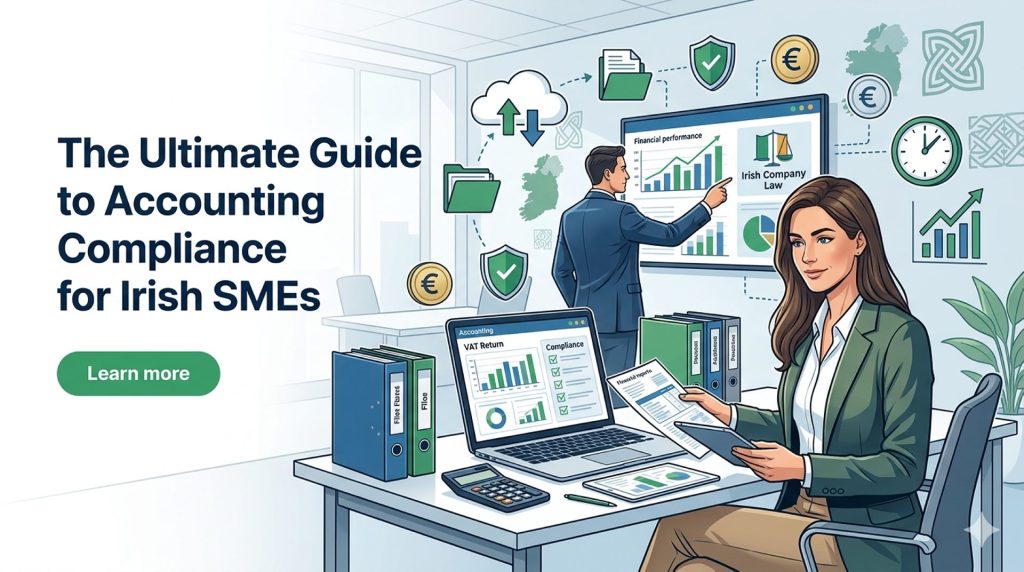
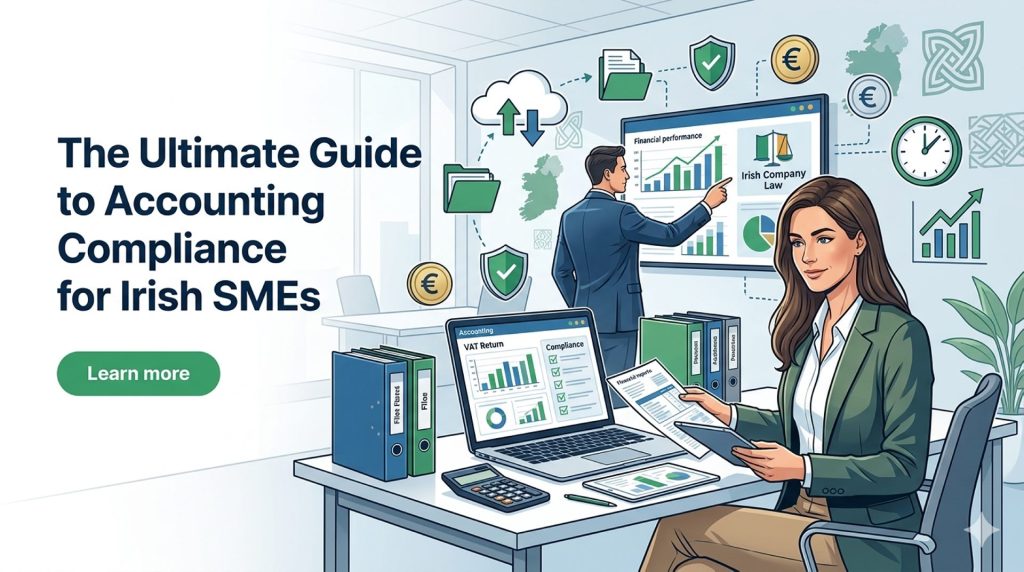
The Ultimate Guide to Accounting Compliance for Irish SMEs
12 May, 2026
By TAS Consulting 140–180 wpm - 13 minutes
Article Overview

Non-EEA Director Bond Service €2000 + VAT
✓ Meets Irish EEA director compliance requirements
✓ Revenue-approved non-resident director bond included
✓ Full documentation and CRO filing support
✓ Fast and hassle-free setup process
✓ Secure handling of all legal records
✓ Ongoing compliance and advisory support
Who Should Read This?
- Irish SME Owners and Directors who need to understand their personal and corporate legal responsibilities.
- New Entrepreneurs setting up a limited company or registering as a sole trader in Ireland.
- Company Secretaries responsible for maintaining statutory filings with the CRO.
- Non-Technical Managers who want a plain-English breakdown of Revenue and Companies Act requirements.
In this guide, you'll find:
- Regulatory Overviews: A breakdown of the roles of Revenue, the CRO, and the Companies Act 2014.
- Record-Keeping Requirements: Exactly what documents you must keep and for how long.
- Taxation Timelines: Deadlines and thresholds for Corporation Tax, VAT, PAYE, and RCT.
- Statutory Financials: An explanation of Irish GAAP, audit exemptions, and iXBRL tagging.
- Penalty Protection: Practical steps to avoid surcharges and the loss of audit exemptions.
- Software Comparisons: A look at Xero, Sage, and QuickBooks within the Irish market.
Key Takeaways
- Deadlines are Absolute: Missing a CRO Annual Return date (B1) results in an immediate fine and the automatic loss of audit exemption for two years.
- Director Responsibility: Under the Companies Act 2014, directors are legally required to ensure "proper" books of account are kept; failure to do so is a criminal offense.
- Modernization is Mandatory: Systems like PAYE Modernization and Enhanced Reporting Requirements (ERR) require real-time or "on-or-before" reporting to Revenue.
- The Six-Year Rule: All business records, from invoices to bank statements, must be retained for at least six years.
- Proactive Management: Compliance is a monthly cycle, not an annual event. Utilizing cloud software significantly reduces the manual burden of these obligations.
The Ultimate Guide to Accounting Compliance for Irish SMEs
Running a small or medium-sized business in Ireland means navigating a compliance landscape that touches Revenue, the Companies Registration Office, and the requirements of the Companies Act 2014 all at the same time, all year round. Miss a deadline, miscalculate a return, or fail to maintain proper records and the consequences range from surcharges and penalties to losing your audit exemption entirely.
This guide covers everything an Irish SME owner needs to know: what you must file, when, with whom, and what happens if you do not. It is written for business owners, not accountants so you will find plain definitions alongside the technical requirements.
What Does "Accounting Compliance" Mean for an Irish Business?
Accounting compliance in Ireland means meeting all your statutory obligations to file accurate financial records, tax returns, and company documents with Revenue, the CRO, and other regulatory bodies within the required deadlines.
In practical terms, it covers your VAT returns, PAYE payroll submissions, corporation tax filings, annual financial statements, and your CRO Annual Return. For a limited company, it also includes obligations under the Companies Act 2014, such as maintaining proper books of account and filing statutory financial statements that comply with Irish GAAP.
Compliance is not a once-a-year task. It is an ongoing, calendar-driven obligation that runs alongside your business every single month.

Who Regulates Irish Business Accounting?
Irish business accounting compliance involves two primary regulatory bodies and one piece of primary legislation:
Revenue Commissioners
Revenue is the Irish government body responsible for the collection of taxes. It administers Corporation Tax, VAT, PAYE, Income Tax, CGT, and all other taxes in Ireland.
Revenue operates through its Revenue Online Service (ROS), which is the mandatory platform for most Irish tax filings. If you are a company, a sole trader with significant income, or VAT-registered, you are almost certainly required to file through ROS. Revenue has extensive audit and investigation powers, and it runs targeted compliance programmes across specific sectors each year.
The Companies Registration Office (CRO)
The CRO is the statutory body in Ireland responsible for the registration of companies and business names. It maintains the public register of all Irish companies and enforces the filing obligations under the Companies Act 2014.
Every Irish limited company must file an Annual Return (Form B1) with the CRO once a year. The Annual Return includes your company's financial statements. The filing deadline is set by reference to your Annual Return Date (ARD), which is the anniversary of your company's last Annual Return. Miss this date and you face late filing penalties of €100 on day one, plus €3 per day thereafter, up to a maximum of €1,200. More significantly, a late B1 filing causes the automatic loss of audit exemption for the next two financial years.
The Companies Act 2014
The Companies Act 2014 is the primary legislation governing Irish companies. It sets out the obligations of directors, the requirements for maintaining proper books of account, and the standards to which financial statements must be prepared.
Under Section 281 of the Companies Act 2014, directors of every Irish company are required to ensure that proper books of account are kept. "Proper" means books that correctly record all money received and spent, assets and liabilities, and that are sufficient to enable a complete and accurate tax return to be prepared. Failure to maintain proper books of account is a criminal offence that can, in serious cases, result in directors being held personally liable for company debts.
What Accounting Records Must an Irish Business Keep?
Under Section 886 of the Taxes Consolidation Act 1997, every Irish business is legally required to keep sufficient records to enable a full and accurate tax return to be made for each accounting period.
These records must be retained for six years after the end of the accounting period to which they relate. This applies to both companies and sole traders.
The records Revenue expects to find include:
- Sales records: All sales invoices issued, whether paper or electronic
- Purchase records: All supplier invoices received
- Bank statements: For all business accounts, including current and deposit accounts
- Payroll records: Employee details, pay slips, PAYE calculations, and all ROS submissions
- VAT records: VAT invoices, credit notes, and the workings behind each VAT return
- Expense records: Receipts for all business expenses claimed
- Asset register: A record of all fixed assets owned by the business and their depreciation
Modern bookkeeping software Xero, Sage, or QuickBooks maintains most of these records automatically when used correctly. Cloud-based receipt capture tools like Dext or Hubdoc can eliminate paper receipts entirely.

What Are the Main Tax Filing Obligations for an Irish SME?
Corporation Tax (CT1)
Corporation tax in Ireland is charged at 12.5% on trading profits for companies resident in Ireland. The standard rate for non-trading (passive) income is 25%.
Every Irish company must file a CT1 Corporation Tax return with Revenue for each accounting period. The key deadlines are:
- Preliminary tax must be paid by the 23rd of the month that is 11 months after the start of the accounting period (or 31 days before the year-end for companies paying by direct debit via ROS)
- The CT1 return and final tax payment must be filed within 9 months of the financial year-end. For a company with a 31 December year-end, this means by 23 September of the following year
Small companies (those whose corporation tax liability in the prior year was €200,000 or less) can base their preliminary tax on 100% of the prior year's liability a useful cashflow tool.
Failure to file or pay on time results in a surcharge of 5% of the tax due (up to €12,695) if filed within two months, rising to 10% (up to €63,485) if filed later.
VAT (Value Added Tax)
VAT is a consumption tax charged on the supply of taxable goods and services in Ireland. The standard rate is 23%, with reduced rates of 13.5%, 9%, and 0% applying to specific categories of goods and services.
The VAT registration thrbesholds in Ireland are:
- €40,000 per annum for persons supplying services
- €80,000 per annum for persons supplying goods
Once registered, most businesses file bi-monthly VAT returns through ROS. Returns are due by the 23rd of the month following the end of the two-month period (e.g., the January–February return is due by 23 March).
Key points that many SMEs overlook:
- Input VAT recovery: You can reclaim VAT paid on business purchases, but only if you hold a valid VAT invoice
- The Annual Return of Trading Details (RTD): A summary VAT return filed once a year, reconciling your VAT records for the full year
- VIES returns: If you supply goods or services to VAT-registered customers in other EU member states, you must file monthly or quarterly VIES returns
What is Relevant Contracts Tax (RCT)? RCT is a withholding tax that applies to payments made by principal contractors to subcontractors in the construction, forestry, and meat processing sectors. If your business engages subcontractors in any of these industries, you are a principal contractor and you must operate RCT through Revenue's electronic RCT system. Deduction rates of 0%, 20%, or 35% apply depending on the subcontractor's compliance record with Revenue. Failure to operate RCT correctly exposes the principal contractor to a 35% RCT liability on every payment made to an unregistered subcontractor.
PAYE Employer Obligations
PAYE (Pay As You Earn) is Ireland's system for collecting income tax, PRSI, and USC from employees at source. Under PAYE Modernisation, introduced in January 2019, employers must report payroll data to Revenue on or before each pay date.
Your employer obligations under PAYE Modernisation include:
- Registering as an employer with Revenue before paying any employee or director
- Submitting a Payroll Submission Request (PSR) to Revenue on or before every pay date
- Deducting and remitting PAYE, PRSI, and USC accurately for each employee
- Filing a monthly P30 (Employer's PAYE return) declaring the total deductions for the month
- Enhanced Reporting Requirements (ERR) from 2024, employers must report certain non-taxable benefits (such as travel and subsistence payments) through a dedicated ERR submission in real time
Directors of Irish limited companies are, in most cases, treated as employees of their own company for PAYE purposes. This means the company must operate PAYE on any salary paid to a director, even if that director is the sole shareholder.
Income Tax for Sole Traders and Company Directors (Form 11)
A sole trader in Ireland is taxed under the Income Tax system rather than Corporation Tax. The self-assessment Form 11 must be filed with Revenue by 31 October each year (or mid-November if filing and paying via ROS), covering the prior tax year.
Directors of Irish limited companies who are also "chargeable persons" broadly, individuals with income that is not fully taxed at source must also file a Form 11 in addition to their company's CT1 return. This is a commonly overlooked obligation that can result in significant surcharges and interest.
GET IN TOUCH
Bringing It All Together
What Are Statutory Financial Statements and Why Do They Matter?
Statutory financial statements are the formal, legally required accounts that every Irish limited company must prepare at the end of each financial year. They must comply with Irish GAAP (FRS 102 or FRS 105) and the Companies Act 2014, and they must be filed with the CRO as part of the Annual Return.
Statutory accounts typically consist of:
- A Directors' Report: A narrative overview of the company's activities and financial position
- A Profit and Loss Account (Income Statement): Showing revenues, costs, and net profit or loss for the year
- A Balance Sheet: Showing assets, liabilities, and shareholders' equity at the year-end date
- Notes to the Financial Statements: Disclosures required by FRS 102 or FRS 105 and the Companies Act 2014
- Independent Auditor's Report: Required if the company does not qualify for audit exemption
What is the audit exemption in Ireland? An Irish company qualifies for audit exemption if it meets at least two of the following three criteria for the current and prior financial year: annual turnover does not exceed €12 million, balance sheet total does not exceed €6 million, and the average number of employees does not exceed 50. Companies that qualify are not required to have their accounts audited. However, audit exemption is lost if the Annual Return is filed late with the CRO.
What Is iXBRL and Does It Apply to Your Business?
iXBRL (Inline eXtensible Business Reporting Language) is a digital tagging format used to file financial statements with Revenue as part of the CT1 Corporation Tax return. Revenue requires financial statements to be tagged in iXBRL format when submitted via ROS.
Mandatory iXBRL filing applies to:
- All companies in the Large Corporates Helpline (LCH) of Revenue
- All companies filing under mandatory e-filing obligations (broadly, all companies)
For smaller companies, the financial statements prepared by your accountant must be tagged in iXBRL before they are submitted to Revenue. This is a technical requirement that most accounting software and tax practices handle automatically but it is worth confirming your accountant is doing this correctly, as an incorrect submission can be treated as non-compliance.
Cloud Accounting Software Choosing the Right Tool for Your Irish SME
Cloud accounting software has transformed the bookkeeping process for small businesses in Ireland. The three dominant platforms are Xero, Sage, and QuickBooks. Each integrates with Revenue's ROS system for VAT filing purposes.
Here is a plain-language comparison:
Xero: Best suited for service-based businesses and SMEs with between 5 and 100 transactions per month. Strong bank reconciliation, excellent app ecosystem, and popular with Irish accountants. Native Irish VAT return formats and RTD support.
Sage: Tends to suit product-based businesses and companies with inventory management needs. More traditional interface, strong payroll module, good for manufacturing and distribution sectors.
QuickBooks: Cost-effective for sole traders and very small businesses. User-friendly, reasonable VAT return support, good receipt capture integration via its mobile app.
Whatever platform you choose, the key principle is this: the software records the transactions, but it cannot replace the expertise of someone who knows what those transactions should look like for your specific business and sector. Cloud software reduces the cost of bookkeeping; it does not eliminate the need for professional oversight.
The Irish Accounting Compliance Calendar Key Deadlines at a Glance
Obligation | Deadline | Filed With |
Bi-monthly VAT return (Jan–Feb) | 23 March | Revenue (ROS) |
Monthly PAYE/PRSI payment | 23rd of following month | Revenue (ROS) |
Preliminary Corporation Tax | Month 11 of accounting period | Revenue (ROS) |
Corporation Tax return (CT1) | Within 9 months of year-end | Revenue (ROS) |
CRO Annual Return (B1) | Company's Annual Return Date | CRO |
Annual Return of Trading Details (RTD) | With final bi-monthly VAT return | Revenue (ROS) |
Form 11 (Income Tax, self-assessed) | 31 October (or mid-November via ROS) | Revenue (ROS) |
VIES returns | Monthly or quarterly (if applicable) | Revenue (ROS) |
ERR (Benefits Reporting) | On or before the payment date | Revenue (ROS) |
What Happens If You Miss a Filing Deadline in Ireland?
Missing a tax or company filing deadline in Ireland triggers automatic penalties, surcharges, or interest charges from Revenue or the CRO.
The consequences vary by obligation:
- Late Corporation Tax return: Surcharge of 5% of tax due (capped at €12,695) if within two months; 10% (capped at €63,485) thereafter
- Late VAT return: Interest accrues at 0.0219% per day on unpaid VAT. Persistent late filing can trigger a VAT audit or estimation of liability by Revenue
- Late PAYE payment: Interest at 0.0274% per day on the amount outstanding
- Late CRO Annual Return (B1): Immediate €100 penalty, then €3 per day up to €1,200 maximum, plus automatic loss of audit exemption for two years
- RCT non-compliance: The principal contractor becomes liable to pay the withheld tax at 35% on all relevant payments made without proper deduction authorisation
The most important point is this: almost all penalties are avoidable with proper diary management and professional oversight. Revenue does not generally seek to penalise businesses that engage proactively but it has very limited sympathy for those who miss deadlines repeatedly.

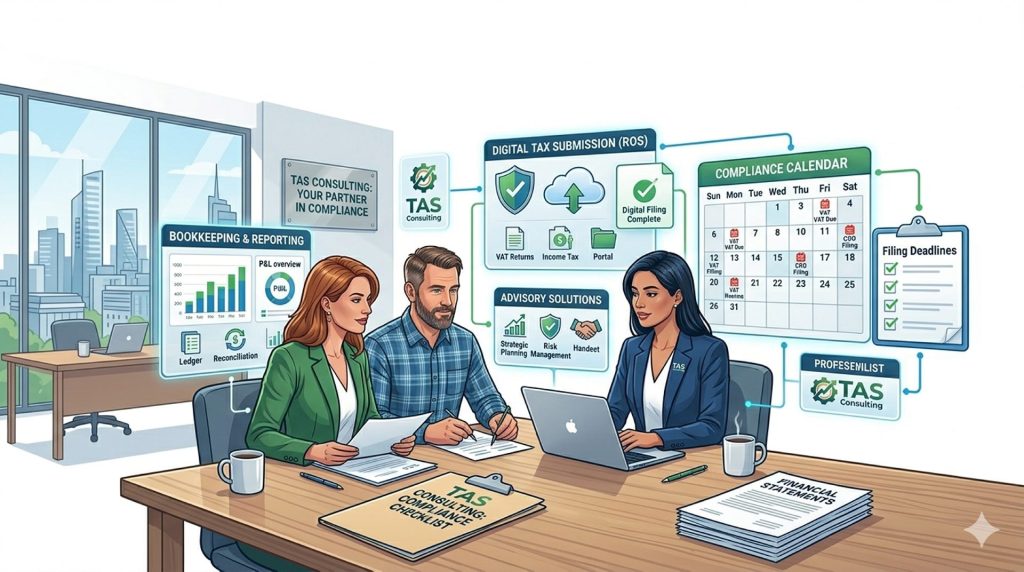
How TAS Consulting Supports Your Compliance
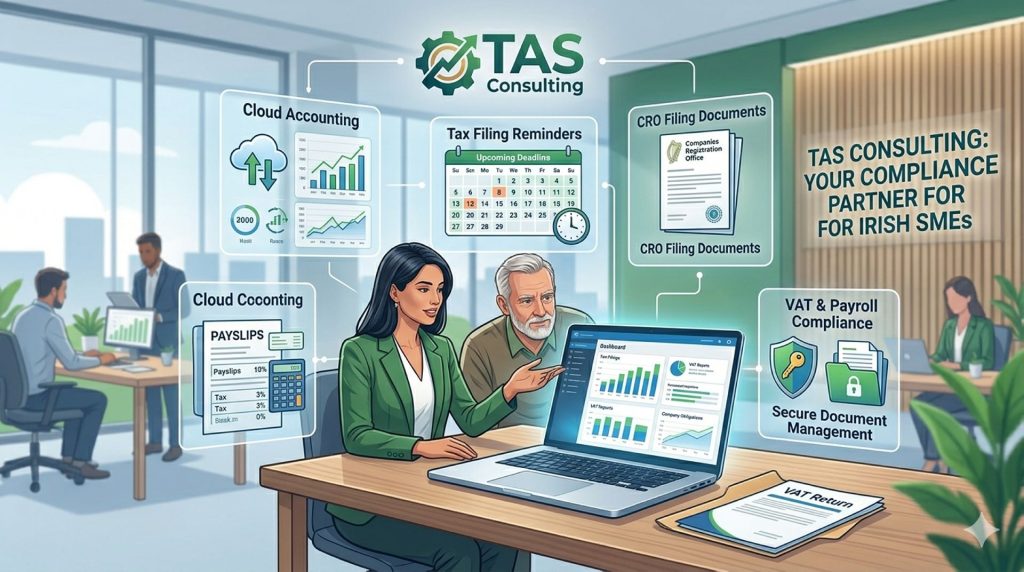
At TAS Consulting, we have been helping Irish SMEs meet every compliance obligation without the stress for over 15 years. Our approach is built on three principles:
- Anticipation: We track every deadline relevant to your business and act before the pressure builds.
- Accuracy: Every return we file is reviewed by a qualified accountant before submission. We do not use junior staff to sign off on work that affects your company's standing with Revenue or the CRO.
- Communication: We contact you when something changes, not after the fact. If a Budget measure affects your payroll, your VAT liability, or your corporation tax planning, you hear about it from us first.
If you would like to review your current compliance position, or if you are simply not confident that everything is being handled correctly, contact us for a free initial consultation.
Start Your Business Journey Now
Hundreds of startups already growing with TAS Consulting
Ready to Make a Change? Talk to TAS Consulting Today
Whether you are appointing a new director, processing a resignation, updating secretary details, or navigating a more complex removal, TAS Consulting manages the full process quickly, correctly, and with full CRO compliance.
Contact Us
Office Address
Unit 80, Cherry Orchard Business Park, D10NX96, Dublin 10, Ireland
Working Hours
Monday to Friday: 0800 hours – 1700 hours
Saturday & Sunday: Closed
Email or Call Us
Email: moh@tasconsulting.ie
Mobile: +353 85 1477625