

Bookkeeping Services in Dublin Complete Guide for Business Owners
15 May, 2026
By TAS Consulting 140–180 wpm - 12 minutes

Article Overview

Non-EEA Director Bond Service €2000 + VAT
✓ Meets Irish EEA director compliance requirements
✓ Revenue-approved non-resident director bond included
✓ Full documentation and CRO filing support
✓ Fast and hassle-free setup process
✓ Secure handling of all legal records
✓ Ongoing compliance and advisory support
Who Should Read This?
This guide is for Dublin business owners, sole traders, company directors, and startup founders who want to understand bookkeeping services what they include, what they cost, how outsourcing compares with hiring in-house, and how to choose the right bookkeeping provider for their business.
It is equally relevant if your current bookkeeping is not working records are behind, VAT returns are being filed late, or you are unsure whether your books are actually accurate. This guide tells you exactly what good bookkeeping should look like and what to do if yours falls short.
In this guide, you'll find:
- A plain English explanation of what bookkeeping services in Dublin actually include
- How Irish Revenue compliance VAT, PAYE Modernisation, RCT connects to your bookkeeping
- A detailed cost comparison between outsourced bookkeeping and hiring an in-house bookkeeper in Dublin
- The most common bookkeeping mistakes Dublin businesses make and how to avoid them
- How to choose the right bookkeeping service for your Dublin business
- What to do if your books are behind or in disarray
Key Takeaways
- Professional bookkeeping in Dublin covers far more than data entry it includes VAT3 return preparation, PAYE Modernisation payroll submissions, bank reconciliation, management reporting, and year-end trial balance preparation
- Outsourcing bookkeeping in Dublin is typically significantly more cost-effective than employing an in-house bookkeeper once salary, employer PRSI, annual leave, and knowledge risk are factored in
- All Dublin businesses with Revenue compliance obligations VAT, employer PAYE, RCT need bookkeeping that is current and accurate at all times, not just at year end
- A qualified Dublin bookkeeper should be proactive flagging approaching deadlines, alerting you to cash flow patterns, and supporting you through any Revenue compliance review
- Choosing an Irish-based provider with specific knowledge of Revenue, CRO, and Companies Act 2014 obligations is essential generic providers miss the Irish-specific requirements that matter

Why Bookkeeping Is the Engine Room of Every Dublin Business
There is a straightforward reason why so many Dublin business owners feel anxious about their accounts. It is not that bookkeeping is especially complicated it is that the consequences of getting it wrong are real, specific, and enforceable.
A VAT3 return filed late attracts interest and penalties from Revenue. A payroll submission made incorrectly under the PAYE Modernisation system creates a compliance discrepancy that Revenue will follow up on. Financial statements filed with the CRO that do not match the underlying records create problems during due diligence. Books that are three months behind mean a business owner making decisions without accurate financial information.
Bookkeeping is not a back-office administrative task. It is the financial infrastructure of your business. Get it right and everything else tax returns, funding applications, business decisions, Revenue compliance runs more smoothly. Let it slide and the cost of catching up is almost always greater than the cost of getting it right from the start.
This guide explains what professional bookkeeping services in Dublin actually deliver, what they cost, and how to choose the right provider for your business.

What Do Bookkeeping Services in Dublin Actually Include?
Snippet-ready answer: Bookkeeping services in Dublin include the recording of all business income and expenditure, bank reconciliation, VAT return preparation and filing, payroll processing, management account production, and year-end trial balance preparation. The scope varies by provider and business size.
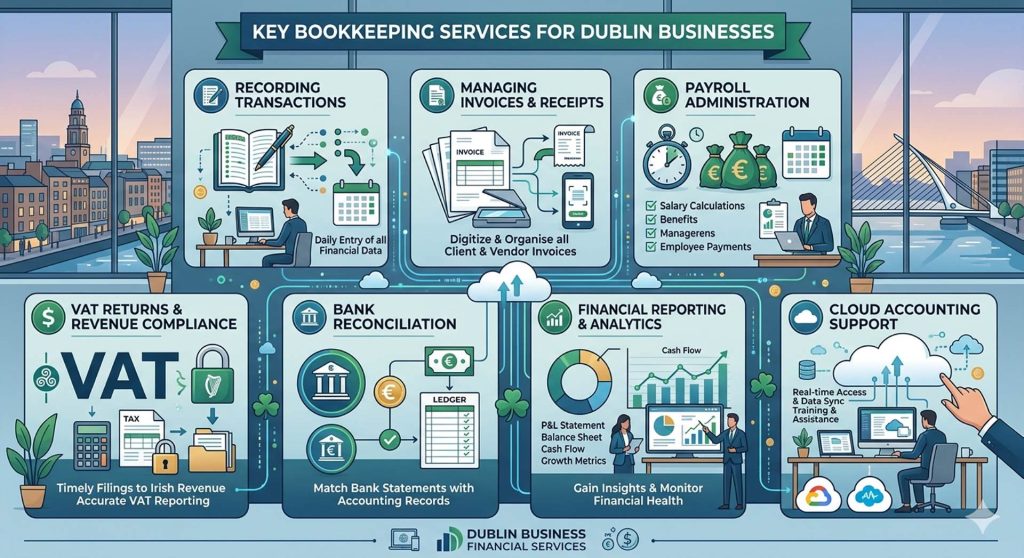
The core functions of a professional Dublin bookkeeping service are:
Transaction Recording: Every financial transaction your business makes every sale, every purchase, every expense must be recorded accurately in your accounting system. This is the most basic function of bookkeeping, and also the most important. Errors at this stage create a cascade of problems through every downstream compliance obligation.
A professional bookkeeper processes your sales invoices, purchase invoices, receipts, and expense claims categorising each transaction correctly in your nominal ledger so that your profit and loss account and balance sheet accurately reflect the financial position of your business.
Bank Reconciliation: Bank reconciliation is the process of matching the transactions in your accounting system against your actual bank statement ensuring that every movement of money in and out of your bank account is accounted for. This is a critical control function. Without regular bank reconciliation, errors and omissions accumulate undetected and the reliability of your financial records degrades over time.
Professional bookkeepers reconcile your bank accounts weekly or monthly depending on your transaction volume and flag any discrepancies for resolution.
VAT Return Preparation and Filing: Irish VAT-registered businesses must file a VAT3 return with Revenue every two months. The return declares your total sales, total purchases, the VAT collected from customers (output VAT), and the VAT paid to suppliers (input VAT). Your net VAT liability or refund is calculated from these figures.
Your bookkeeper calculates your VAT position from your transaction records, prepares the VAT3, and files it through Revenue Online Service (ROS) before the bi-monthly deadline. They also maintain a VAT reconciliation a record that explains how the VAT return figure was arrived at which is essential documentation in any Revenue compliance review.
Payroll Processing and PAYE Modernisation: Since January 2019, every Irish employer is required to submit payroll data to Revenue in real time under the PAYE Modernisation system. A Payroll Submission Request (PSR) must be made on or before the date each employee is paid. There is no end-of-year catch-up the obligation is per payroll run, every time.
Your bookkeeper runs payroll using compliant software, submits the PSR to Revenue for each run, and ensures that the employer PAYE payment (the P30) is made on time each month. They also manage starters and leavers, BIK processing, and any mid-year changes to employee terms.
Management Accounts: Management accounts are monthly or quarterly financial reports that give you the business owner or director a clear picture of how your business is performing. A standard set of management accounts includes a profit and loss statement, a balance sheet, and a cash flow statement.
Management accounts are distinct from statutory financial statements (which are prepared annually for the CRO). They are an internal management tool but a vital one. Without reliable monthly management accounts, you are making business decisions without accurate financial information.
Year-End Trial Balance: At the end of your financial year, your bookkeeper prepares a fully reconciled trial balance a complete list of all nominal ledger account balances. This is the document your accountant or auditor uses to prepare your statutory financial statements, corporation tax return, and CRO annual return. Well-maintained books make this process fast and cost-effective. Books that are poorly kept make it slow, expensive, and stressful.
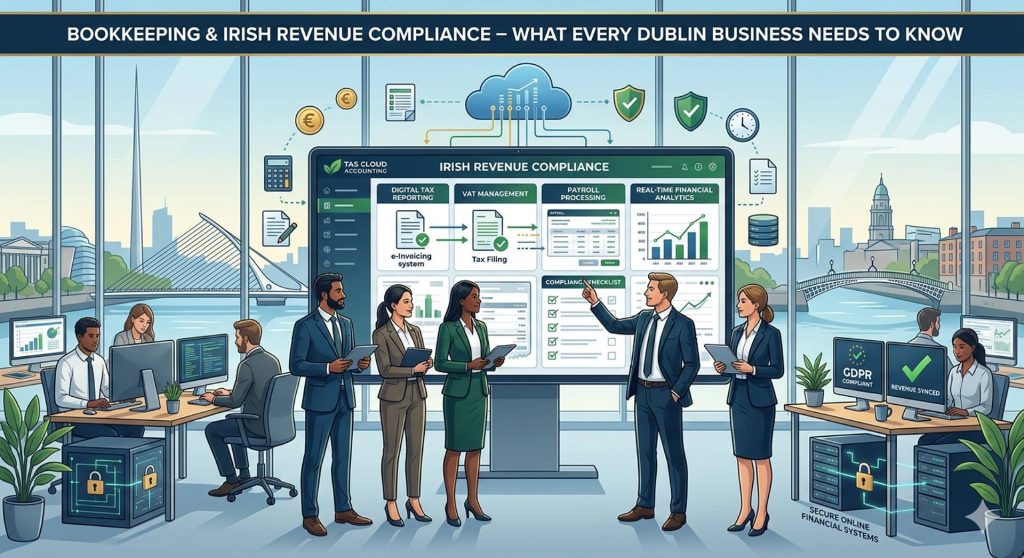
Bookkeeping and Irish Revenue Compliance What Every Dublin Business Needs to Know
Bookkeeping and Revenue compliance are inseparable for any Dublin business with tax obligations. Here is how they connect.
VAT Compliance: The Irish VAT system operates on a self-assessment basis your business calculates its own VAT liability and reports it to Revenue every two months. Revenue does not calculate it for you. This means the accuracy of your VAT return is entirely dependent on the accuracy of your bookkeeping.
Common VAT errors that stem from poor bookkeeping:
- Input VAT claimed on non-deductible expenses (entertainment, motor expenses above permitted thresholds)
- Incorrect VAT rates applied to goods or services (particularly relevant for hospitality, where 9% and 13.5% rates apply to different items)
- VAT not charged on services supplied to Irish business customers that should have been
- Intrastat and VIES returns missing or incorrect for businesses trading with EU counterparties
Revenue has the right to audit your VAT records for any return filed in the previous four years (longer in cases of fraud or deliberate non-compliance). Clean, well-maintained bookkeeping is your first and best defence.
PAYE Modernisation The Real-Time Payroll System: Ireland's PAYE Modernisation system fundamentally changed the employer payroll obligation from 2019. Under the old system, employers filed a P35 at year end summarising payroll for the full year. Under PMOD, every payroll run generates a real-time submission to Revenue Revenue can see your payroll data within days of each payment.
This means errors are visible to Revenue almost immediately. Under-reported income, incorrect tax credits applied, payroll run without a PSR submission Revenue's compliance systems flag these discrepancies and follow up.
A bookkeeper who manages your payroll correctly under PMOD eliminates this risk entirely. Every submission is accurate, every payment is on time, and your employer PAYE record with Revenue is clean.
RCT Relevant Contracts Tax: RCT applies to businesses in the construction, forestry, and meat processing sectors that make payments to subcontractors. It is a withholding tax system with specific real-time obligations:
- Before any contract begins, the principal contractor must notify Revenue through ROS (Contract Notification)
- Before each payment is made, the principal must notify Revenue of the payment amount and request a deduction authorisation
- Revenue responds with a deduction authorisation specifying the withholding rate 0%, 20%, or 35% based on the subcontractor's tax compliance record
- The principal withholds the specified amount and pays it to Revenue
- A monthly RCT return (Form RCT30) must be filed summarising all subcontractor payments
RCT is an area of genuine complexity for Dublin construction businesses. The obligation is triggered at payment time not at month end which means a payment made without the correct notification procedure creates a non-compliance immediately. Many construction firms in Dublin outsource their RCT management specifically to ensure every payment is correctly handled.
CRO Annual Return and Financial Statements: Every Irish limited company must file an annual return with the CRO under the Companies Act 2014. Financial statements profit and loss account and balance sheet must be attached to the annual return for most companies. The annual return must be filed within 28 days of the company's Annual Return Date.
Late CRO filings attract financial penalties and, for persistent non-compliance, can result in the company being struck off the register. The quality of your bookkeeping directly determines how quickly and accurately your annual return financial statements can be prepared.
GET IN TOUCH
Bringing It All Together
The Real Cost of Bookkeeping in Dublin In-House vs Outsourced
This is the question that most Dublin business owners eventually ask, and the answer is almost always in favour of outsourcing.
The true cost of an in-house bookkeeper in Dublin
A qualified bookkeeper in Dublin commands a salary of €32,000–€42,000 depending on experience. But the salary is only part of the cost:
- Gross salary: €35,000 (illustrative midpoint)
- Employer PRSI (11.15%): €3,900
- Annual leave (20+ days): approximately €1,350 in lost productivity and cover costs
- Sick leave: statutory entitlements plus potential extended absence
- Training and CPD: €500–€1,500 per year
- Software licences: €500–€1,200 per year depending on platform
True annual cost: €41,000–€52,000: before the cost of recruiting a replacement if the person leaves, which typically adds one to two months' salary to the total.
There is also a knowledge concentration risk with a single in-house bookkeeper. If they leave, go on extended sick leave, or take parental leave, your books stop being maintained. Catching up from a gap in bookkeeping is expensive and disruptive particularly if a VAT return or payroll submission falls in the gap period.
The cost of outsourced bookkeeping in Dublin
Outsourced bookkeeping is priced based on transaction volume and the scope of services required. For a typical Dublin SME monthly bank reconciliation, bi-monthly VAT, weekly payroll for five to ten employees, and monthly management accounts professional outsourced bookkeeping costs a fraction of an equivalent in-house salary.
Beyond the direct cost comparison, outsourcing eliminates:
- Management overhead of supervising a bookkeeping employee
- Recruitment and replacement costs
- Knowledge concentration risk
- Holiday and sick leave coverage problems
- Training and software costs
Sector-Specific Bookkeeping Needs in Dublin
Different Dublin business sectors have specific bookkeeping requirements that generic providers sometimes miss.
Hospitality Restaurants, Cafés, and Pubs: Dublin hospitality businesses deal with multiple VAT rates on the same transaction. Food at 0%, hot food at 9% (reduced rate for tourism and hospitality), alcohol at 23%, service charges, tip pooling arrangements, and cash management all create complexity that requires specialist attention. PAYE compliance for part-time, casual, and seasonal staff adds another layer. Businesses in this sector benefit significantly from a bookkeeper who has experience with hospitality-specific accounting.
Construction Builders, Developers, and Tradespeople: RCT management is the critical bookkeeping obligation for Dublin construction businesses. Beyond RCT, construction bookkeeping involves tracking costs against projects, managing retention payments, dealing with VAT on property transactions (which follows specific reverse-charge rules), and monitoring subcontractor relationships. A bookkeeper without RCT experience is not equipped to handle a construction business's books correctly.
IT Contractors and Consultants: Dublin's technology sector generates a significant number of contractors operating through Personal Service Companies (PSCs). For these businesses, bookkeeping covers director salary and dividend processing, monthly management accounts, quarterly VAT returns, and preparation for annual corporation tax returns. The key for IT contractors is keeping clean records that clearly differentiate between personal and business expenses an area where many self-managed books fall short.
Retail: Dublin retail bookkeeping involves POS system integration, stock management, management of split VAT rates (23% on most goods, 0% on children's clothing and food), supplier credit terms, and cash handling reconciliation. Cloud accounting platforms with POS integration Xero, QuickBooks, and Sage all support this significantly reduce the manual workload for retail bookkeeping.
E-Commerce: Dublin e-commerce businesses selling to EU consumers have specific VAT obligations under the EU One Stop Shop (OSS) scheme, which allows them to report VAT across all EU member states through a single Irish OSS registration. Managing multi-channel sales data from Shopify, WooCommerce, Amazon, and similar platforms into a single accurate accounting record requires bookkeeping experience with e-commerce integrations.
What to Do If Your Books Are Behind
One of the most common situations we encounter is a Dublin business owner who comes to us with books that have not been properly maintained sometimes for months, occasionally for longer. This is more common than most people realise, and it is almost always fixable.
Here is the practical process for catching up on overdue bookkeeping:
Step 1: Assess the gap. Identify the last point at which your records were reliably accurate. This is your starting point.
Step 2: Gather source documents. Bank statements, sales invoices, purchase invoices, receipts, and payroll records for the catch-up period all need to be assembled. Cloud banking apps and document storage tools like Dext can accelerate this process significantly.
Step 3: Reconstruct and reconcile. Every transaction in the catch-up period is processed and the accounts are reconciled to the bank statements. This establishes a clean, accurate position.
Step 4: Address any compliance gaps. If VAT returns or payroll submissions are overdue during the catch-up period, these must be filed. Late filing penalties will apply, but voluntary disclosure to Revenue filing late but proactively is always treated more favourably than waiting for Revenue to identify the gap.
Step 5: Establish ongoing bookkeeping. Once the catch-up is complete, a reliable monthly bookkeeping process is put in place so the situation does not recur.
TAS Consulting provides catch-up bookkeeping as a specific service. Most catch-up engagements for Dublin businesses are completed within two to four weeks of instruction.

Bookkeeping Mistakes Dublin Businesses Make
Mixing personal and business finances: Using a personal bank account for business transactions is the single most common bookkeeping problem among sole traders and new company directors. It creates a record-keeping nightmare and makes it impossible to accurately calculate business income and expenses. A dedicated business bank account is not optional it is fundamental.
Leaving bookkeeping until year end: Many Dublin business owners treat bookkeeping as something to deal with before the accountant asks for records at year end. This approach leads to VAT penalties (VAT is due every two months, not annually), payroll compliance failures, and a scramble to reconstruct records from memory and bank statements. Monthly bookkeeping is not a luxury it is a compliance requirement.
Not reconciling the bank: Without regular bank reconciliation, errors and omissions accumulate silently. A supplier payment processed twice, a direct debit missed in the accounts, a payment received but not matched to an invoice all of these remain undetected until the bank is reconciled. By then, the volume of errors is larger and the resolution is more time-consuming.
Incorrectly claiming VAT on non-deductible expenses: VAT cannot be claimed on certain categories of expenditure entertainment costs, most motor expenses for non-commercial vehicles, and personal expenses accidentally processed through the business. Claiming input VAT incorrectly results in an underpayment of VAT that Revenue will assess, plus interest, in a compliance review.
Failing to maintain supporting documentation: Revenue requires that businesses retain records invoices, receipts, bank statements, payroll records for a minimum of six years. Books that are not supported by documentation cannot be relied upon in a Revenue audit. Cloud accounting tools with document attachment features Xero, Dext, Hubdoc make this straightforward, but only if they are consistently used.
Not telling your bookkeeper about business changes: A new employee, a new bank account, a new supplier in an EU country, a contract with a UK business post-Brexit all of these have bookkeeping and compliance implications. Bookkeepers who are not told about changes cannot account for them correctly.

How to Choose the Right Bookkeeping Service in Dublin
With a significant number of bookkeeping providers in Dublin, choosing the right one matters. Here is what to look for.
Qualified professionals: Ask specifically about qualifications. Accounting Technicians Ireland (ATI), ACCA, ACA, and equivalent qualifications indicate a bookkeeper who has been trained to a recognised professional standard. Unqualified bookkeepers can maintain basic records, but they lack the technical grounding to handle complex transactions, VAT issues, or Revenue queries correctly.
Irish tax knowledge: Your bookkeeper must understand Irish Revenue requirements specifically Irish VAT rates and rules, PAYE Modernisation, RCT, and CRO compliance. This is not the same as general bookkeeping knowledge. Always ask whether the provider has specific experience with Irish Revenue compliance, not just accounting software.
Fixed pricing: Hourly billing makes costs unpredictable for routine bookkeeping. A reputable provider should quote a fixed monthly fee based on your transaction volume and the services required. This aligns incentives you pay for results, not for hours spent.
A full-service firm: A bookkeeping provider that also offers accounting, tax, payroll, and company secretarial services gives you a single point of contact for all your compliance obligations. This eliminates duplication, reduces cost, and ensures your bookkeeping is always connected to the broader tax and compliance picture.
Proactive communication: Good bookkeepers do not wait for you to ask questions. They alert you to approaching VAT deadlines, flag cash flow patterns worth noting, and tell you immediately if Revenue correspondence arrives. Ask any prospective provider how they communicate with clients and what their response time commitment is.
Proven experience in your sector: Construction businesses need RCT experience. Hospitality businesses need multi-rate VAT knowledge. E-commerce businesses need OSS and platform integration experience. Always ask whether the provider has worked with businesses in your specific sector.

Let's Get Your Books Right
Whether you need bookkeeping from scratch, a catch-up on overdue records, or a switch from a provider that is not delivering, TAS Consulting is ready to help. Get in touch today for a free initial consultation and a clear, fixed quote.
Start Your Business Journey Now
Hundreds of startups already growing with TAS Consulting
Contact Us
Office Address
Unit 80, Cherry Orchard Business Park, D10NX96, Dublin 10, Ireland
Working Hours
Monday to Friday: 0800 hours – 1700 hours
Saturday & Sunday: Closed
Email or Call Us
Email: moh@tasconsulting.ie
Mobile: +353 85 1477625