Year-end accounts are a legal requirement for every Irish limited company and a practical necessity for sole traders. This guide explains what they include, when they are due, how to prepare them, and how to use year-end as an opportunity not just an obligation.


Year-End Accounts in Ireland Complete Guide for Businesses
19 May, 2026
By TAS Consulting 140–180 wpm - 13 minutes

Article Overview

Non-EEA Director Bond Service €2000 + VAT
✓ Meets Irish EEA director compliance requirements
✓ Revenue-approved non-resident director bond included
✓ Full documentation and CRO filing support
✓ Fast and hassle-free setup process
✓ Secure handling of all legal records
✓ Ongoing compliance and advisory support
Who Should Read This?
This guide is for Irish business owners whether you run a limited company, operate as a sole trader, or are a startup approaching your first financial year-end. If you have ever felt confused about CRO filing deadlines, corporation tax, or what your accountant actually needs from you, this guide will make it clear.
In this guide, you'll find:
- What year-end accounts are and what they must include under Irish law
- All key filing deadlines for CRO, Revenue, VAT, and payroll
- A step-by-step year-end checklist for Irish businesses
- Tax planning opportunities to act on before the books close
- Common year-end mistakes and how to avoid them
- Answers to the most frequently asked questions
Key Takeaways
- Every Irish limited company must file an Annual Return with the CRO and a CT1 with Revenue each year even if not trading
- Your financial year-end in Ireland is not fixed to 31 December you can choose any 12-month period
- A late CRO Annual Return costs up to €1,200 and triggers a two-year loss of audit exemption
- Year-end is a valuable window for tax planning capital allowances, pensions, and R&D credits can all reduce your liability if actioned in time
- Starting your year-end preparation six to eight weeks before your closing date avoids most of the common problems
Year-End Accounts Ireland A Complete Guide for Businesses
Year-end accounts. For many business owners in Ireland, those three words come with a familiar mix of mild dread and last-minute scrambling. Deadlines appear. Documents go missing. The accountant asks for things you are not entirely sure you have.
It does not need to be that way. Year-end accounting, when approached in the right order and with the right preparation, is a manageable process and it is also one of the most valuable things you do for your business all year. It tells you exactly where you stand, what you owe, and what decisions to make going forward.
This guide walks you through everything you need to know, in plain English.
What Are Year-End Accounts?
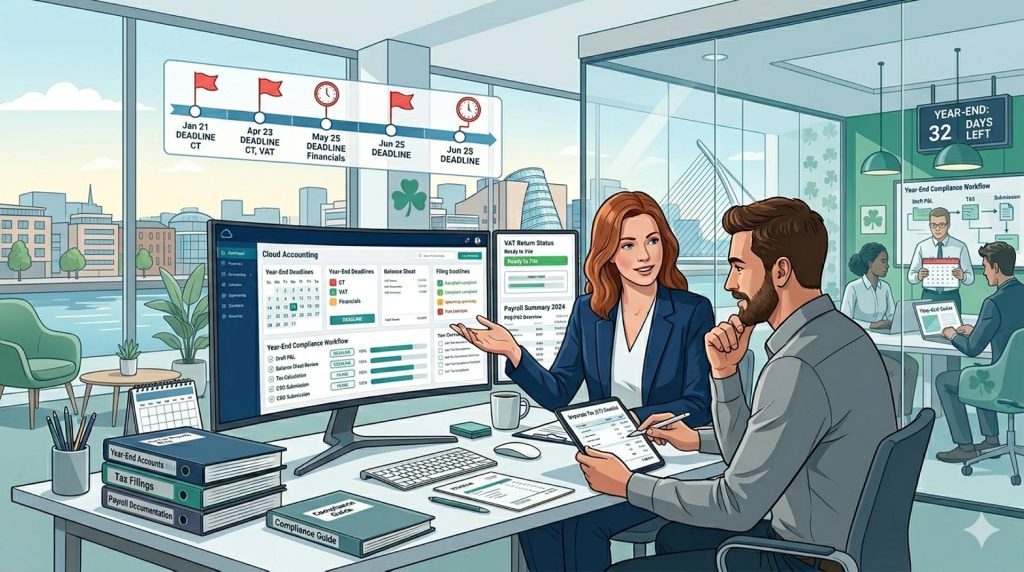
Year-end accounts also referred to as annual accounts, financial statements, company accounts, or statutory accounts are a formal record of your business's financial activity over a 12-month accounting period.
For Irish limited companies, these accounts must be prepared in line with the Companies Act 2014 and filed with two separate bodies:
The Companies Registration Office (CRO): as part of your Annual Return, accompanied by Form B1. Revenue as the basis for your Corporation Tax Return (CT1).
For sole traders and self-employed individuals, year-end accounts form the basis of your Form 11 income tax return, filed annually with Revenue.
A complete set of year-end accounts for an Irish company typically includes:
The Profit and Loss Account (Income Statement): A summary of all income earned and expenses incurred during the financial year. This shows whether your business made a profit or a loss.
The Balance Sheet: A snapshot of your business's financial position on the last day of your financial year what you own (assets), what you owe (liabilities), and what is left over (equity).
Notes to the Accounts: Supporting detail required by Irish company law, including accounting policies, breakdown of significant figures, and details on directors' loans or transactions.
Director's Report: A short narrative by the directors confirming the company's activities, financial position, and compliance status.
Form B1 (Annual Return): The document filed with the CRO each year, containing company registration details, director information, share details, and a confirmation that your financial statements are attached.

Does Your Business Need to File Year-End Accounts?
In short: if you operate a limited company in Ireland, yes without exception. Under the Companies Act 2014, every incorporated company is legally required to prepare and file annual accounts with the CRO, regardless of whether the company is trading, profitable, dormant, or newly incorporated.
If you are a sole trader or in a partnership, you are not required to file with the CRO, but you do need year-end accounts to complete your income tax return with Revenue. Without accurate accounts, it is impossible to calculate your taxable income correctly or claim the deductions you are entitled to.
Your Financial Year-End Date in Ireland
One of the most common points of confusion for Irish business owners is that the financial year does not have to end on 31 December. Unlike many other countries, Irish companies can choose any 12-month accounting period. Common year-end dates include 31 December, 31 October, 31 March, and 30 April but any date is permissible.
If you are a newly incorporated company, your first financial year-end must fall within 18 months of your date of incorporation. After that, each financial year runs for exactly 12 months (with a permitted variation of up to 7 days) from the last year-end.
You can change your financial year-end date, but only once every five years under normal circumstances. To do so, you file a Form B83 with the CRO before the filing deadline for the period you are changing.
Knowing your exact year-end date is the starting point for everything else all your filing deadlines flow from it.
GET IN TOUCH
Bringing It All Together
Key Year-End Deadlines for Irish Businesses
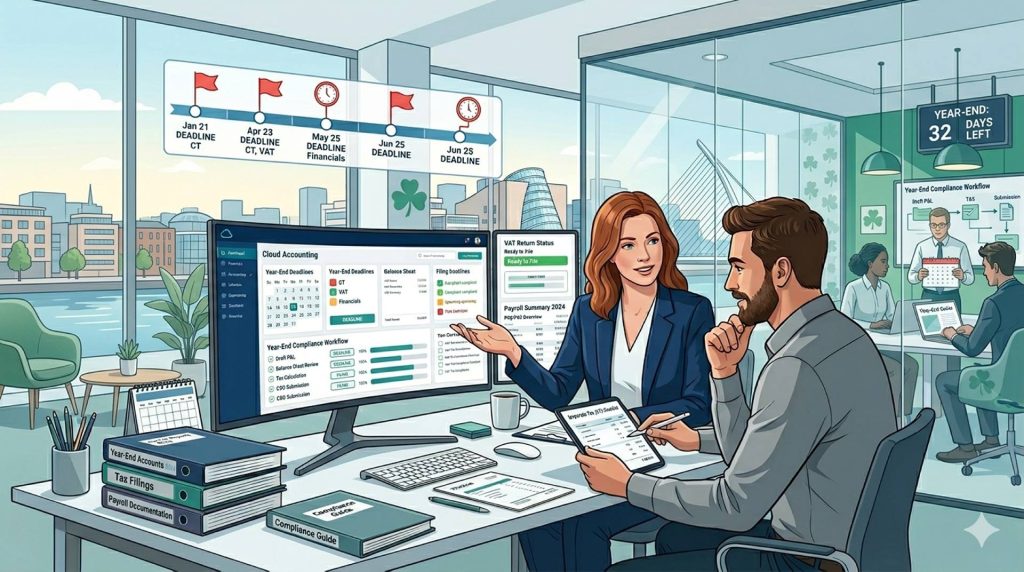
Missing a deadline with Revenue or the CRO is costly. Here are the dates that matter:
CRO Annual Return: Due within 28 days of your Annual Return Date (ARD). The ARD is typically the anniversary of your incorporation date or the date you last filed. The CRO will send a reminder email approximately six weeks before your ARD, but do not rely on that as your only alert.
Corporation Tax Return (CT1): Due nine months after the end of your financial year. So if your year-end is 31 December 2025, your CT1 is due by 23 September 2026.
Preliminary Tax: For companies not in their first year, Preliminary Tax is payable 31 days before the financial year-end. For larger companies (with CT liability over €200,000 in the prior year), an initial payment is due six months into the financial year. Getting this wrong either way is expensive: underpay and Revenue charges interest at 8% per annum; overpay and you tie up working capital unnecessarily.
Income Tax Form 11 (Sole Traders): Due 31 October each year, or the extended deadline for ROS (Revenue Online Service) filers, typically mid-November.
VAT Returns: If you are on bi-monthly VAT returns, each return is due by the 19th of the month following the end of the period. The final period of your financial year should be reconciled and confirmed as part of your year-end close.
Employer Record Returns (ERR): Under Revenue's PAYE Modernisation rules, all employer payroll returns must be submitted in real time, monthly. At year-end, confirm that all ERRs are accurate and reconcile to your accounts.
Capital Gains Tax: If you disposed of any assets during the year, CGT is payable by 15 December for disposals made between January and November, and by 31 January of the following year for December disposals.
Year-End Accounts Checklist for Irish Businesses
Starting your year-end preparation six to eight weeks before your closing date gives you the time to work through this properly rather than rushing at the last minute.
Step 1 Reconcile all bank accounts and credit cards: Every transaction in your accounting software should match your bank statement. Investigate any discrepancies immediately. Do not leave items in a suspense account.
Step 2 Review outstanding debtors: Chase any unpaid invoices before your year-end date cash received before closing strengthens your balance sheet. For debts you cannot collect, formally write them off as bad debts. In Ireland, a bad debt deduction is available against corporation tax where the debt can be shown to be genuinely irrecoverable.
Step 3 Reconcile accounts payable: Confirm all supplier invoices are correctly recorded. Accrue for any goods or services received but not yet invoiced failing to do so will overstate your profit and create a tax liability you do not actually owe yet.
Step 4 Check prepayments: If you have paid in advance for services that extend beyond your year-end insurance, software subscriptions, rent only the portion relating to the current year belongs in this year's profit and loss account. The balance goes on the balance sheet as a prepayment.
Step 5 Review and categorise all expenses: Separate capital expenditure (equipment, machinery, vehicles) from revenue expenditure (office supplies, subscriptions, utilities). Capital items are depreciated over their useful life; revenue items are expensed immediately. Mixing the two affects both your profit figure and your tax liability.
Step 6 Complete payroll year-end: Confirm all Employer Record Returns (ERRs) have been submitted accurately for the year. Check that employee PAYE, PRSI, and USC have been correctly applied. Correct any errors through Revenue's myEnquiries portal before closing out.
Step 7 Reconcile your VAT position: Your VAT account should show exactly what you owe Revenue (or what Revenue owes you). Reconcile your full-year VAT returns to your sales and purchases ledgers. Look carefully for any VAT incorrectly claimed on non-business expenses or exempt purchases these are frequent audit triggers.
Step 8 Update your fixed assets register: Add any assets purchased during the year. Apply the correct depreciation. Remove any assets that were sold or scrapped. For Irish corporation tax purposes, capital allowances on plant and machinery are claimed at 12.5% per annum over eight years.
Step 9 Prepare your financial statements: With all reconciliations complete, your profit and loss account, balance sheet, and notes to the accounts can be finalised. For most Irish SMEs, these are prepared under FRS 102 (Irish GAAP) or FRS 105 if the company qualifies as a micro-entity. Comparative figures from the prior year must be included.
Step 10 Check your audit exemption status: Irish companies are exempt from a statutory audit if they meet at least two of three criteria: turnover under €12 million, balance sheet total under €6 million, and fewer than 50 employees. Note: if your CRO Annual Return is filed late, you lose this exemption for two years another reason to file on time.
Step 11 Back up all financial records: Revenue requires Irish businesses to retain records for a minimum of six years. Store everything securely ideally in a cloud-based system with multiple backups. This includes invoices, bank statements, payroll records, and VAT documentation.
Step 12 Brief your accountant early: Give your accountant or accounting team a structured handover: a summary of the year, any unusual transactions, any new assets, loans, or changes in ownership. The earlier they can start, the better your outcome will be.
Tax Planning Opportunities Before Year-End
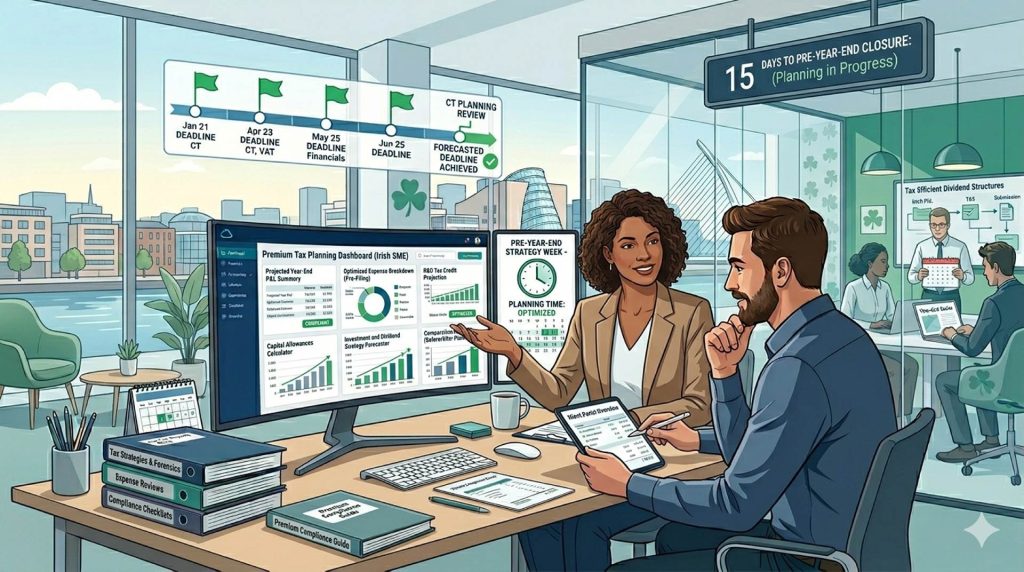
Year-end is not purely about compliance. It is one of the best opportunities in your financial calendar to take legal steps that reduce your tax bill.
Capital Allowances: If you are considering purchasing equipment, machinery, or commercial vehicles, buying before your financial year-end rather than after means you can claim capital allowances in the current tax year. The standard rate in Ireland is 12.5% per annum over eight years for plant and machinery, with a full write-off available in some cases for energy-efficient equipment.
Director Pension Contributions: Pension contributions made by a company on behalf of a director are a fully deductible business expense for corporation tax purposes, subject to Revenue's age-related limits. Making a pension contribution before year-end is one of the most tax-efficient moves available to owner-managed companies.
R&D Tax Credits: Ireland offers a 30% tax credit on qualifying research and development expenditure one of the most generous R&D regimes in Europe. Many Irish SMEs are carrying out qualifying activities without realising it. Software development, product testing, process improvement speak to your accountant before the year closes to check eligibility.
Bad Debt Write-Offs: If you have invoices you genuinely cannot collect, writing them off before year-end reduces your taxable income for the period. The debt must be demonstrably irrecoverable, not just overdue.
Salary vs Dividend Review. For owner-managed companies, the split between director salary and dividend affects both your personal income tax and the company's PRSI obligations. The optimal balance depends on your specific position this is worth reviewing annually before the books close.
Preliminary Tax Planning. Getting your Preliminary Tax figure right close enough to your actual liability without overpaying is a cash flow decision worth making carefully. Your accountant can model this based on your expected year-end profit.
Year-End Accounting Mistakes Irish Businesses Make
Leaving everything to the last two weeks: Compressed timelines cause errors. Bank reconciliations get skipped. Accruals get forgotten. The resulting accounts are less accurate, and the filing is more stressful than it needs to be.
Missing the CRO Annual Return date: The penalty is immediate €100 on the day, then €3 every day after, up to €1,200. But the bigger cost is the two-year loss of audit exemption, which adds both expense and administrative burden to subsequent filings.
Confusing capital and revenue expenditure: A laptop bought for the business is a capital item it does not belong in office supplies. Misclassifying capital expenditure as revenue expenditure distorts your profit figure and affects your tax liability in both directions.
Omitting accruals and prepayments: Your profit and loss account should reflect what your business earned and spent during the year not just what was invoiced or paid. Forgetting accruals overstates profit; forgetting prepayments understates it.
Not reconciling VAT: VAT errors are one of the most common triggers for a Revenue compliance intervention. A clean VAT reconciliation at year-end is both good practice and good risk management.
Underestimating Preliminary Tax: Revenue charges interest at 8% per annum on underpaid Preliminary Tax. This is entirely avoidable with a careful estimate based on your expected year-end results.
Not retaining records: Revenue can raise an audit query up to four years after the relevant filing date, and further back where fraud or neglect is suspected. You need retrievable records for everything. A structured digital archive is the most practical solution.
What Documents Does Your Accountant Need?
To prepare your year-end accounts, your accountant will typically need:
- Business bank statements for the full 12-month period
- Sales invoices and a summary of all income received
- Purchase invoices and receipts for all business expenses
- Payroll records and confirmation that all ERRs were submitted correctly
- VAT return records for the year
- Details of any assets purchased or disposed of during the year
- Loan agreements or financing documents entered into during the year
- Signed declarations from a company director and the company secretary (for the Form B1)
The more organised this information is when it reaches your accountant, the faster and cheaper the process will be.
Sole Traders vs Limited Companies Key Differences at Year-End
For sole traders, year-end accounts feed directly into your Form 11 self-assessment tax return. There is no CRO filing requirement, and your accounts do not need to be prepared to the same formal standard as a limited company. However, the quality of your bookkeeping still directly affects the accuracy of your tax return and the legitimacy of your expense claims.
For limited companies, the year-end process is more structured. You must prepare statutory financial statements, file a Form B1 with the CRO, and submit a CT1 corporation tax return to Revenue. The standards are higher and the deadlines are stricter, but the tax efficiency available to a limited company is also greater.
If you are a sole trader wondering whether to incorporate, your year-end accounts will give you the data you need to make that decision properly.
Start Your Business Journey Now
Hundreds of startups already growing with TAS Consulting
Ready to Make a Change? Talk to TAS Consulting Today.
Whether you are appointing a new director, processing a resignation, updating secretary details, or navigating a more complex removal, TAS Consulting manages the full process quickly, correctly, and with full CRO compliance.
Frequently Asked Questions
What is the purpose of year-end accounts?
Year-end accounts provide an accurate picture of your business's financial performance and position. They are a legal requirement for limited companies and the basis for tax returns across all business structures. They also give you the information you need to make better decisions in the year ahead.
What financial statements are included in Irish year-end accounts?
A typical set includes the profit and loss account, balance sheet, notes to the accounts, and a director's report. Limited companies also file a Form B1 Annual Return with the CRO.
Can a company file its own year-end accounts without an accountant?
Technically, yes there is no legal requirement to use an accountant. In practice, the risk of error and the potential cost of penalties, incorrect tax returns, or loss of audit exemption make professional preparation worthwhile for most businesses.
What accounting standard applies to Irish companies?
Most Irish SMEs prepare accounts under FRS 102 (the Financial Reporting Standard applicable in the UK and Republic of Ireland) or FRS 105 for micro-entities. Larger companies or those with international operations may use IFRS.
What happens if I do not file my year-end accounts at all?
For limited companies, failure to file leads to escalating CRO fines, loss of audit exemption, and ultimately can result in the company being struck off the register. Revenue can also apply surcharges to late or missing tax returns. Acting early even if you are behind is always better than waiting.
Contact Us
Office Address
Unit 80, Cherry Orchard Business Park, D10NX96, Dublin 10, Ireland
Working Hours
Monday to Friday: 0800 hours – 1700 hours
Saturday & Sunday: Closed
Email or Call Us
Email: moh@tasconsulting.ie
Mobile: +353 85 1477625
TAS Consulting | Expert Company Formation & Business Solutions in Ireland
Dublin's trusted provider for official company formations, Revenue tax compliance, and transparent monthly accounting services.