

PAYE Umbrella Company Ireland
04 May, 2026
140–180 wpm - 12 minute read
Article Overview

Non-EEA Director Bond Service €2000 + VAT
✓ Meets Irish EEA director compliance requirements
✓ Revenue-approved non-resident director bond included
✓ Full documentation and CRO filing support
✓ Fast and hassle-free setup process
✓ Secure handling of all legal records
✓ Ongoing compliance and advisory support
Who Should Read This?
This guide is written for contractors, freelancers, and professionals in Ireland who want to clearly understand how PAYE umbrella companies work and how they get paid. It is especially relevant for those starting a contract, moving into contracting for the first time, or required by an agency or client to work under a PAYE structure.
If you are unsure about tax, PRSI, compliance, or whether you should set up a limited company, this guide will help you understand your options and choose the right structure from the beginning.
In this guide, you'll find:
- A clear, plain-English explanation of how a PAYE umbrella company works in Ireland
- A step-by-step breakdown of how payments flow from your client or agency to your bank account
- A detailed overview of PAYE, PRSI, and USC deductions and what they mean for your take-home pay
- Practical guidance on allowable expenses and how they impact your net income
- A comparison between PAYE umbrella, director umbrella, and limited company structures
- Key compliance points to help you stay aligned with Revenue requirements
Key Takeaways
- A PAYE umbrella company allows you to work as a contractor while being employed under PAYE, removing the need to manage your own company or tax filings
- It is the most suitable option for first-time contractors, short-term contracts, or when PAYE is required by your agency or client
- Your income is taxed at source (PAYE, PRSI, USC), offering simplicity and full compliance but less tax flexibility compared to a limited company
- Class A PRSI contributions provide access to full Irish social welfare benefits, including illness and jobseeker’s support
- A compliant umbrella provider should offer real-time payroll processing, transparent fees, and full adherence to Revenue regulations
Why So Many Irish Contractors Are Asking About PAYE Umbrella Companies
Ask any recruitment consultant in Ireland what the most common question they get from new contractors is, and the answer is almost always the same: "How do I actually get paid?"
It sounds simple. In practice, it involves decisions about tax structure, PRSI class, Revenue compliance, and whether to form your own company questions that most people starting out in contracting have never had to think about before.
The PAYE Umbrella Company has become the most popular answer to that question for first-time and short-term contractors across Ireland. It is quick to set up, requires almost no administration, keeps you fully compliant with Revenue, and lets you retain Class A PRSI entitlements that you would lose if you went self-employed.
But it is also a model that is frequently misunderstood, and choosing the wrong umbrella provider or the wrong structure entirely can cost you real money.
This guide explains everything you need to know about PAYE Umbrella Companies in Ireland in 2026. By the time you finish reading, you will know exactly how the model works, what you will actually take home, what expenses you can claim, who it suits and who it does not, and what to look for in a provider.
What Is a PAYE Umbrella Company? The Plain English Explanation
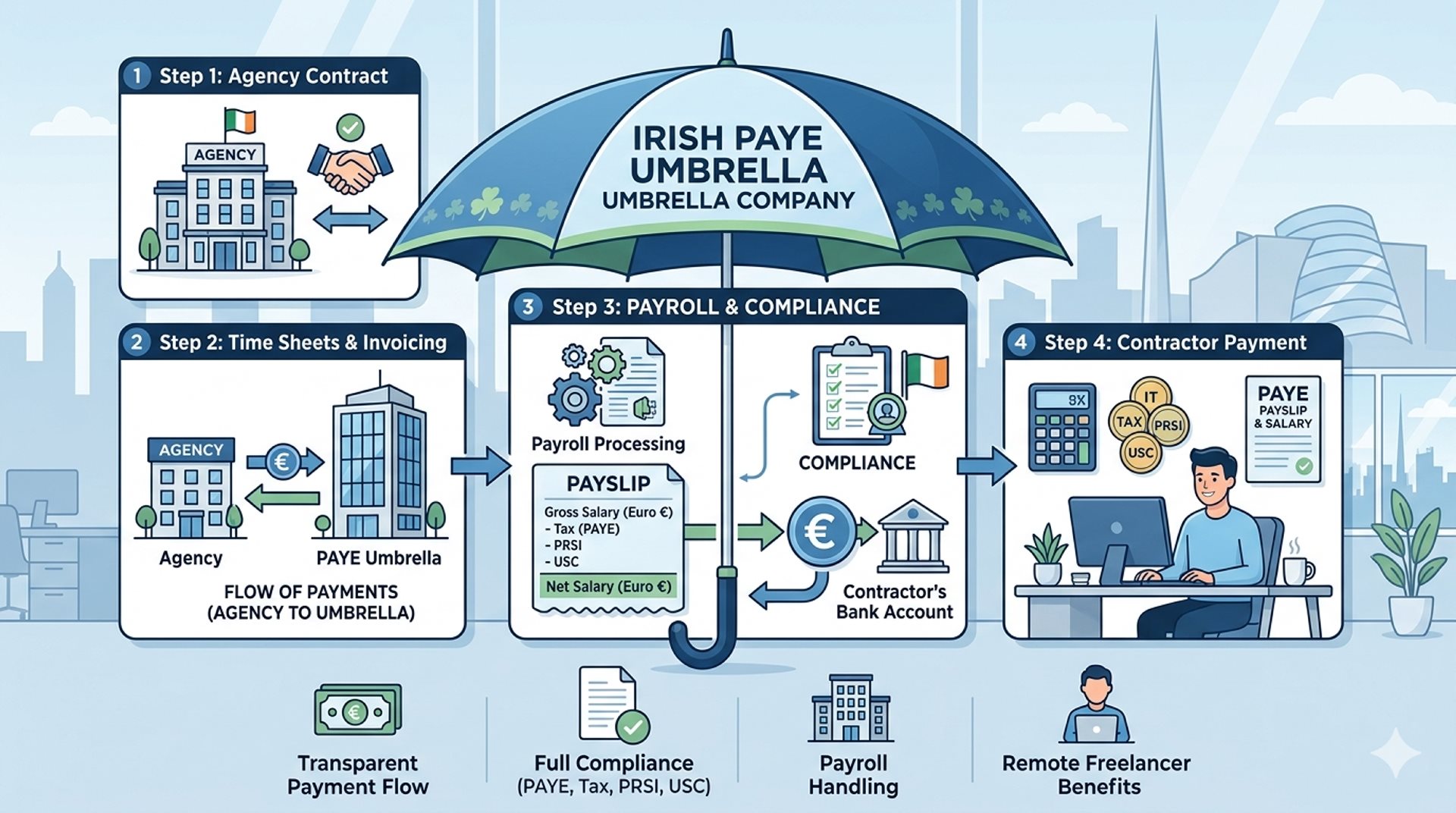
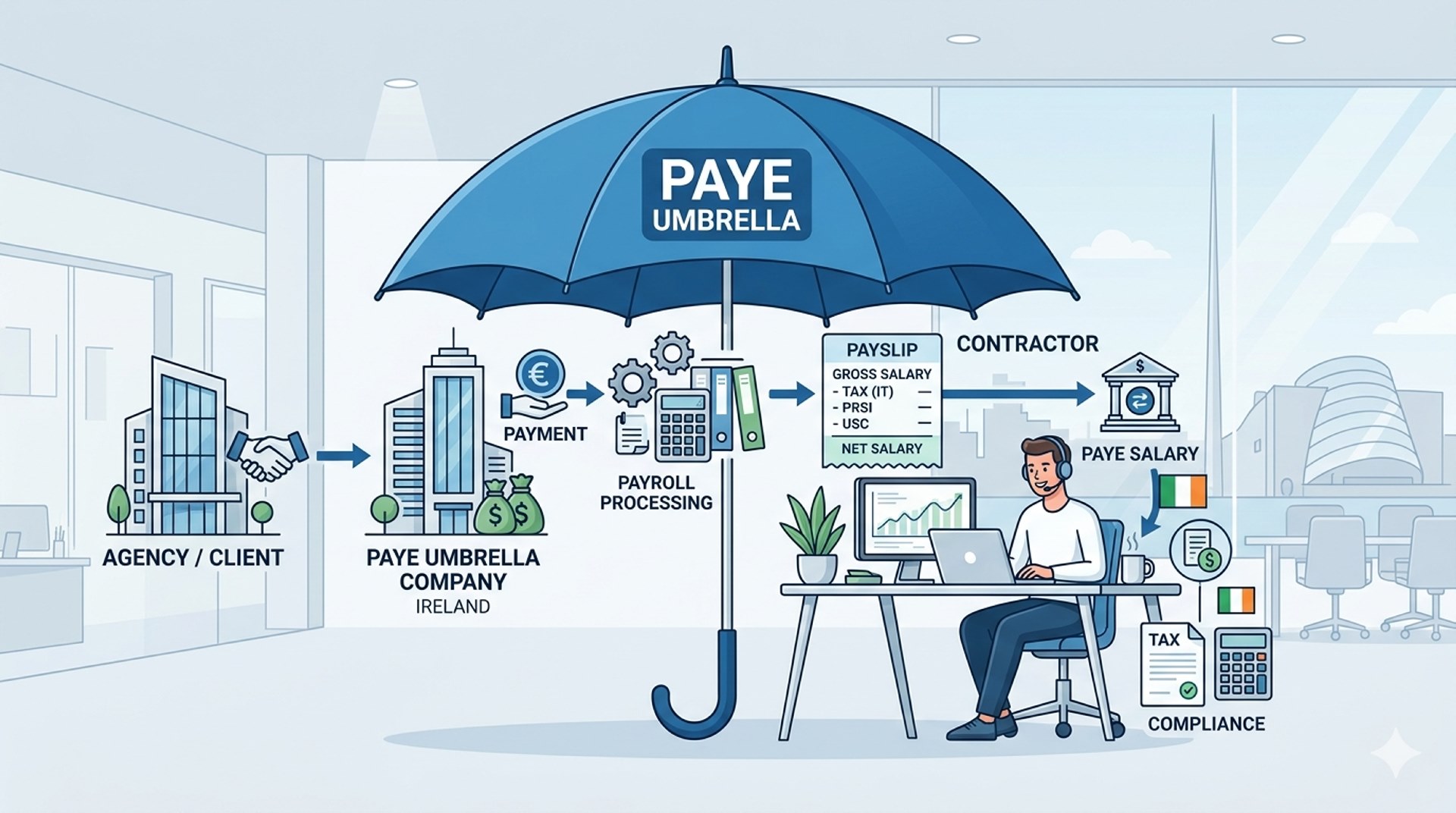
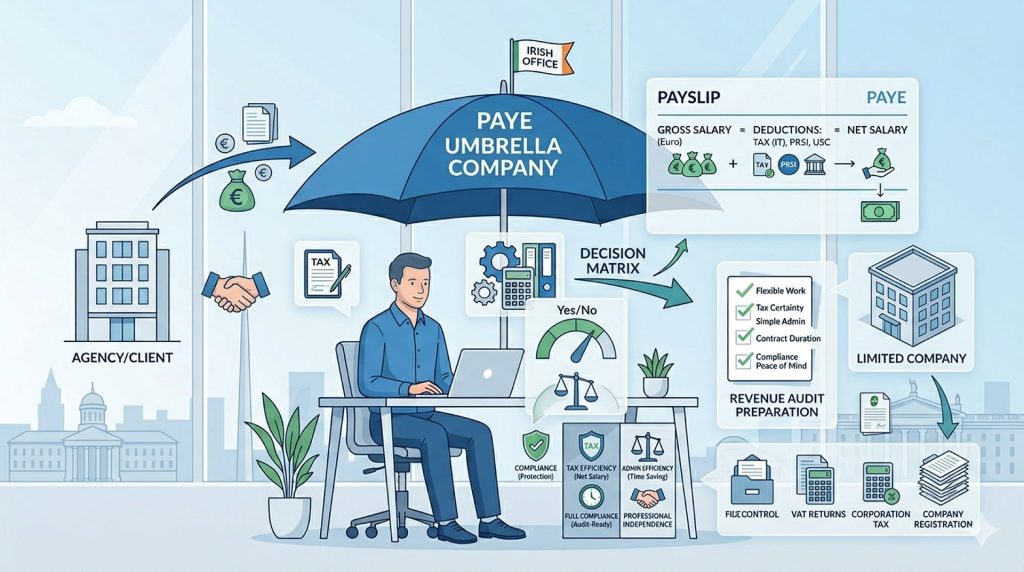
A PAYE Umbrella Company is a type of employer that sits between you the contractor and the client or agency paying for your work.
When you work through a PAYE Umbrella Company:
- You become an employee of the umbrella company for payroll and tax purposes
- The umbrella invoices your agency or client for your services
- The agency or client pays the umbrella
- The umbrella deducts your PAYE income tax, PRSI, and USC, remits them to Revenue, and pays you your net salary with a detailed payslip
You remain an independent contractor in every practical sense. You negotiate your own rates, work with your own clients, and choose your own contracts. The umbrella simply handles the administrative and compliance layer that sits beneath all of that.
The term "PAYE" refers to the Pay As You Earn tax system, which is the standard payroll system used by employers across Ireland. When an umbrella company processes your pay through PAYE, it means your taxes are deducted at source before the money reaches you exactly as they would be if you were in permanent employment.
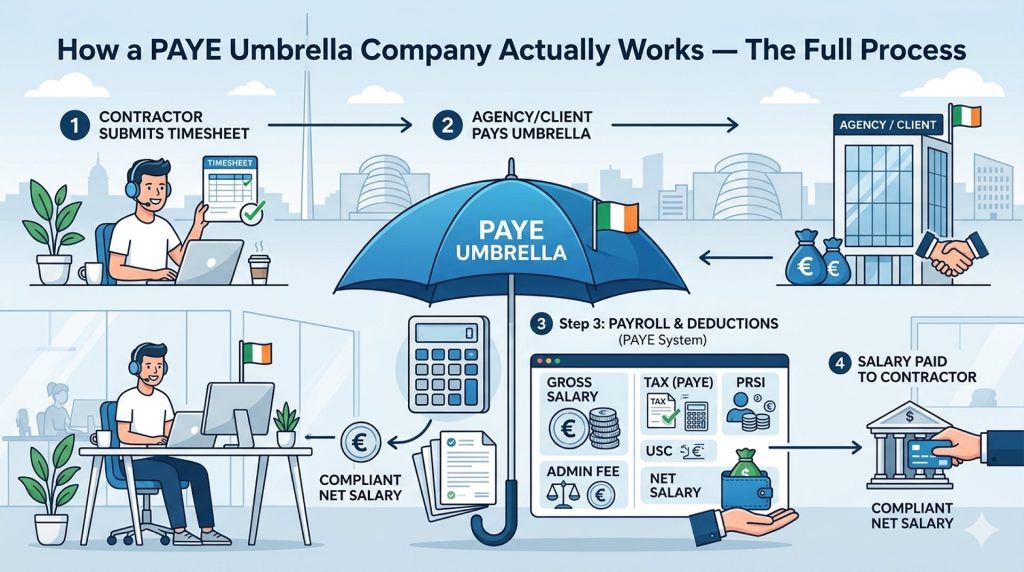
How a PAYE Umbrella Company Actually Works The Full Process
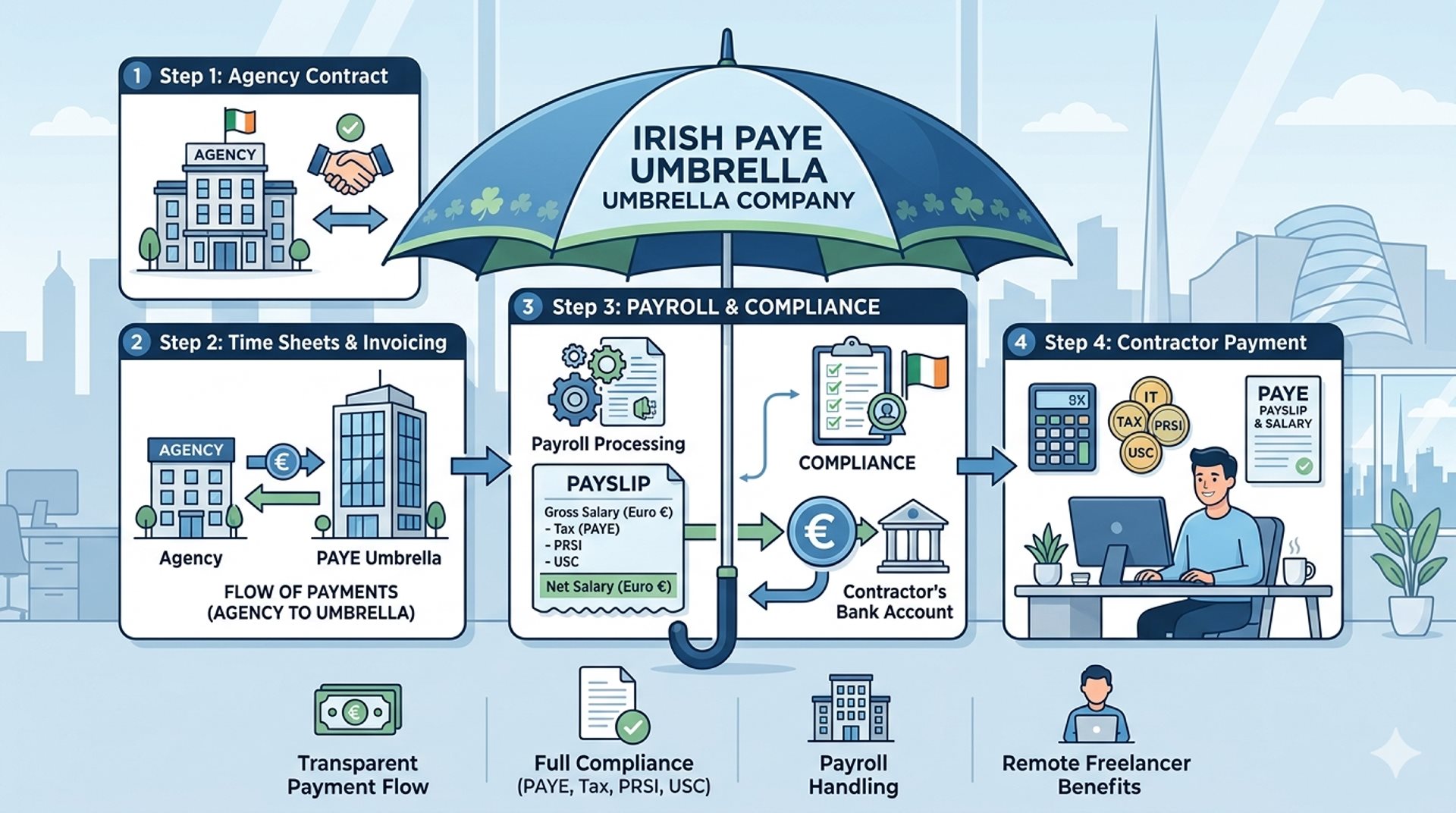
Understanding the mechanics of the arrangement helps you see why it is both compliant and efficient. Here is how the money and paperwork flows:
Step 1: You win a contract You secure a contract directly with a client or through a recruitment agency. The contract rate is agreed in the normal way.
Step 2: The umbrella enters a Contract for Services The umbrella company enters into a formal Contract for Services with your agency or end client. This legally establishes the working relationship between all three parties.
Step 3: You sign a contract of employment You sign an employment contract with the umbrella company. This is what makes you an employee of the umbrella for payroll and tax purposes.
Step 4: You work and submit timesheets You complete your work and submit timesheets (and any expense claims) to the umbrella company at the end of each pay period.
Step 5: The umbrella invoices the agency or client The umbrella raises an invoice for the total amount due, including VAT where applicable, and manages all credit control.
Step 6: Payment is received and payroll is processed Once the invoice is paid, the umbrella runs payroll. This involves calculating your gross pay, deducting PAYE income tax, PRSI (both employee and employer contributions), and USC, and remitting all of these to Revenue in real time under the PAYE Modernisation system (PMOD).
Step 7: You receive your net pay Your net salary is transferred directly to your bank account, accompanied by a full payslip showing every deduction line by line.
This entire cycle typically happens weekly or monthly, depending on your contract terms.
PAYE, PRSI, and USC What Gets Deducted and How Much
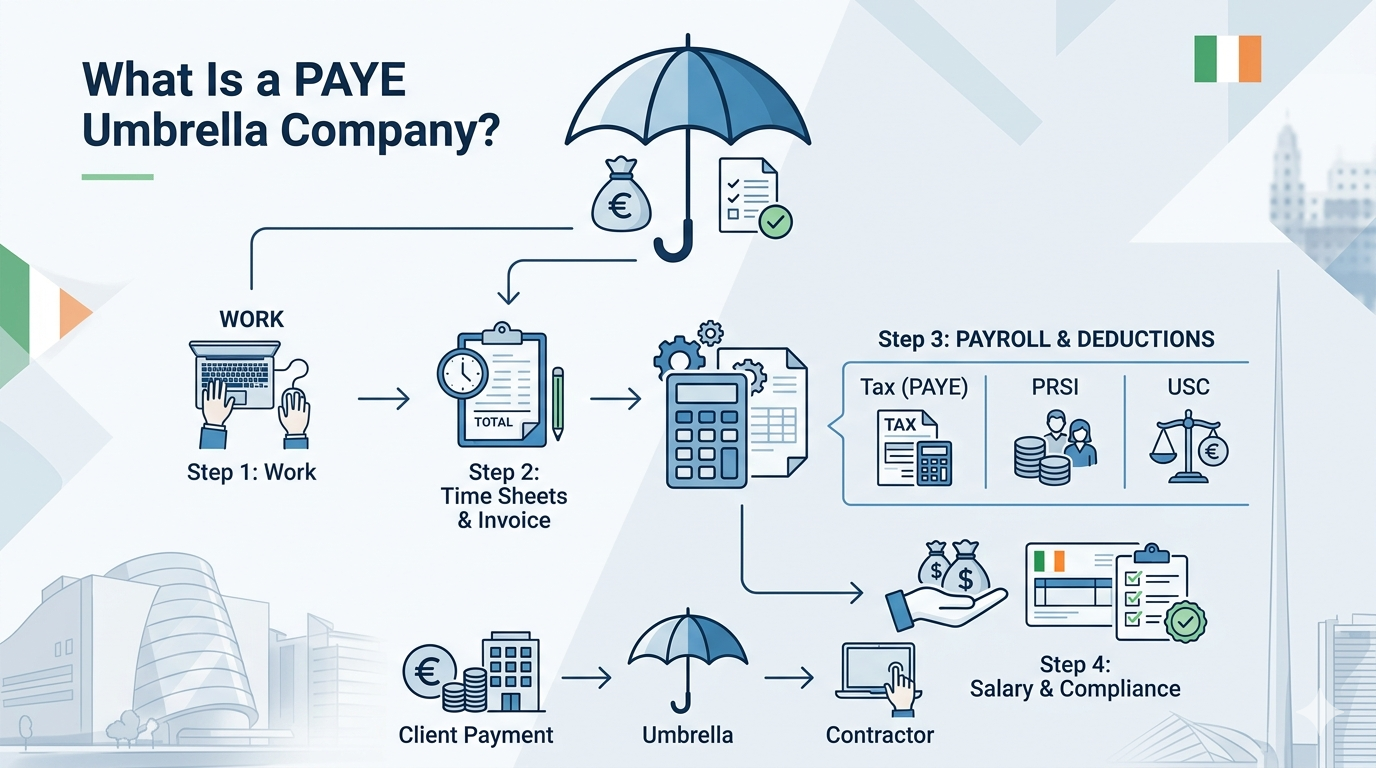
For many contractors, the tax question is the one that causes the most anxiety. Here is a clear breakdown of what the three main deductions actually are.
PAYE Income Tax
Ireland uses a two-rate income tax system. In 2026, you pay 20% on income up to €44,000 (single person) and 40% on income above that threshold. Your umbrella calculates and applies these rates to your gross pay each period. Your tax credits (personal, PAYE, and any others you are entitled to) reduce the amount of tax you actually pay.
PRSI Pay Related Social Insurance
Under the PAYE Umbrella model, you pay Class A PRSI. This is one of the most important features of the model Class A is the same PRSI class paid by permanent employees, and it gives you full access to social welfare benefits including Illness Benefit, Jobseeker's Benefit, Maternity Benefit, and contributions toward the State Contributory Pension.
One thing every PAYE umbrella contractor needs to understand: you pay both the employee PRSI contribution (4%) and the employer PRSI contribution (currently 11.15% on earnings above the weekly threshold). This is not a peculiarity of any specific provider it is how the PAYE umbrella model works across the entire Irish market. Because you are the commercial beneficiary of the arrangement, both contributions come from your contract rate. The upside is that your Class A entitlements are protected in full.
USC Universal Social Charge
USC is charged on gross income at tiered rates. Incomes below €13,000 are exempt. Above that, rates apply in bands currently 0.5%, 2%, and 4% depending on income levels. Your umbrella deducts USC from each payslip.
GET IN TOUCH
Bringing It All Together
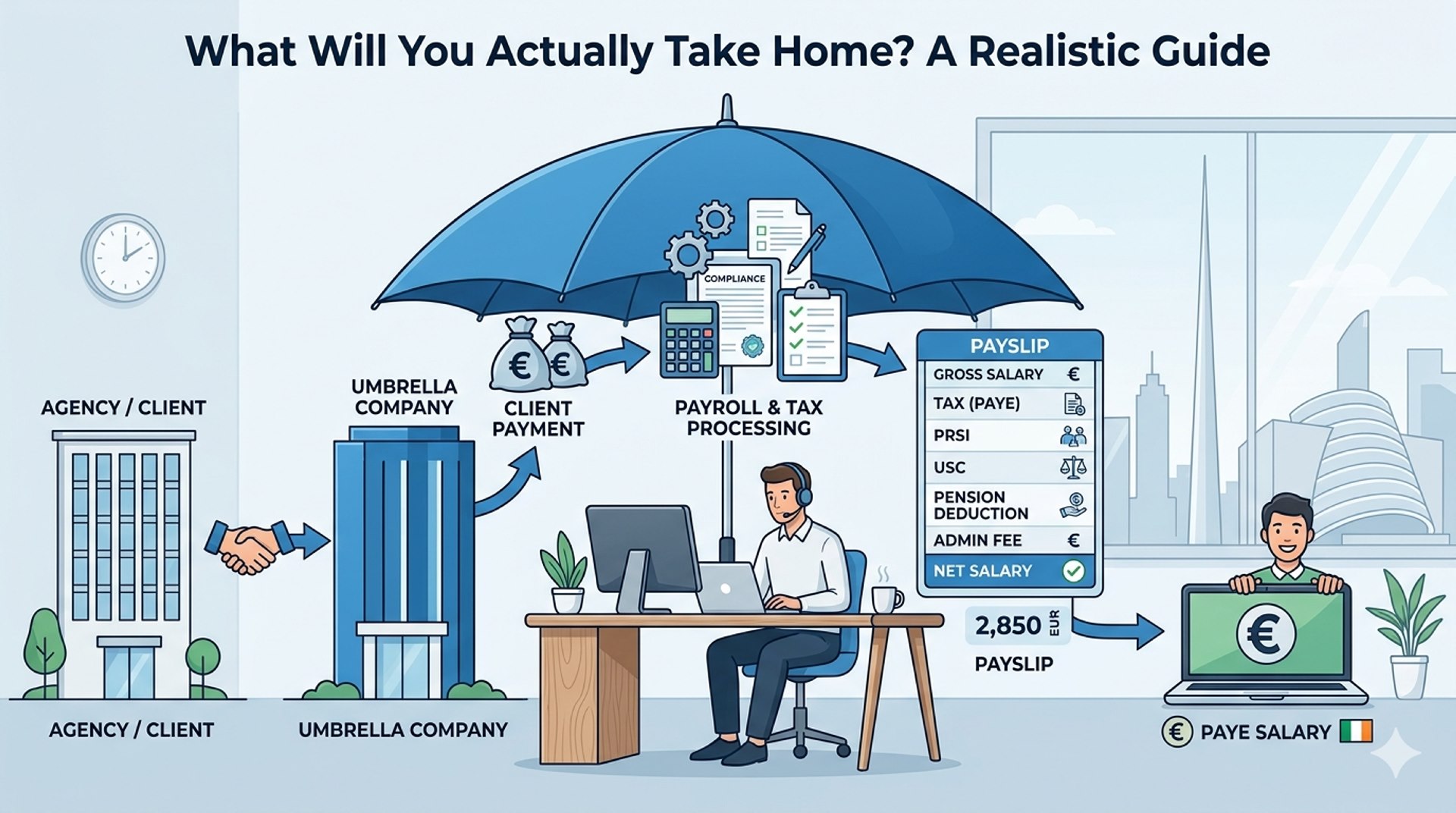
What Will You Actually Take Home? A Realistic Guide
Take-home pay under a PAYE umbrella depends on a handful of variables:
- Your daily or hourly contract rate
- The length and frequency of your working weeks
- Your personal tax credits (including any additional credits you may be entitled to)
- The business expenses you can legitimately claim
- Your umbrella provider's service fee
No responsible umbrella provider or blog post can give you a single accurate take-home figure without knowing these variables. What you can and should expect from your provider is a personalised take-home calculation before you sign up, based on your specific rate and circumstances.
A word on inflated take-home promises
If any umbrella company quotes you a take-home percentage that seems unusually high particularly anything above 85–90% of gross treat it with serious caution. Non-compliant schemes that artificially boost take-home pay through loan arrangements, trust structures, or disguised remuneration do exist. Revenue actively investigates them. If Revenue finds a shortfall, the tax liability falls on you not the umbrella provider. The principle is simple: if it sounds too good to be true, it is.
What Expenses Can You Claim Through a PAYE Umbrella?
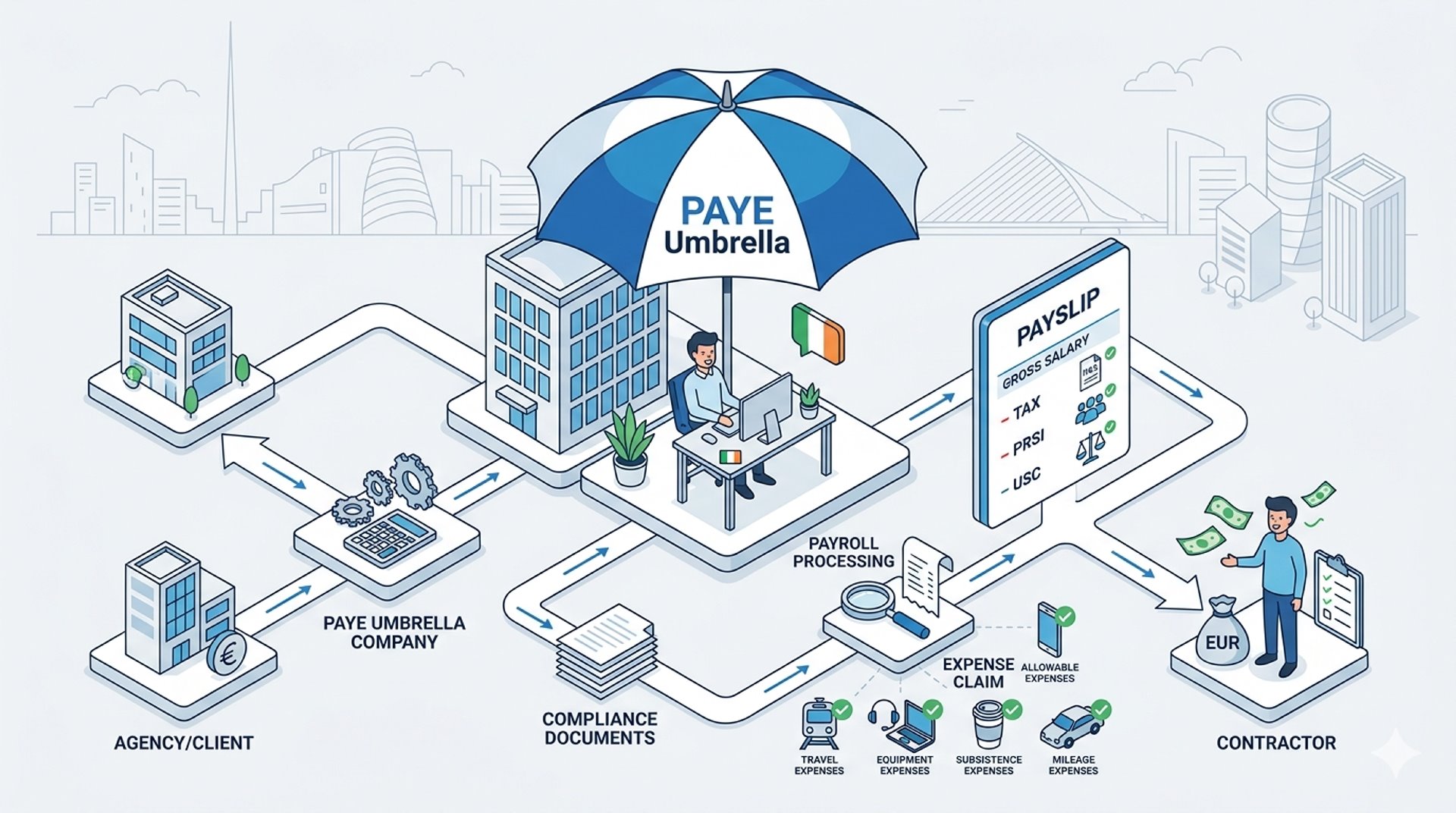
Claiming legitimate expenses reduces your taxable income, which means lower PAYE and USC deductions and a higher net pay. Under the PAYE umbrella model, the Revenue standard for claimable expenses is that costs must be wholly, exclusively, and necessarily incurred in the performance of your duties. This is a stricter standard than the one that applies to limited company directors, but it still covers a meaningful range of work-related costs.
Common claimable expenses for PAYE umbrella contractors:
- Travel between separate client sites (not home-to-work commuting)
- Professional membership fees and subscriptions directly related to your work
- Work-specific equipment purchased exclusively for the performance of your duties
- Professional training and courses required for your work
- The Revenue remote working daily allowance (€3.20 per day worked from home exempt from PAYE, PRSI, and USC)
What you generally cannot claim under PAYE:
- Normal home-to-office commuting costs
- Home office overheads such as broadband and utilities (these fall under the broader director/limited company rules)
- Costs that have a personal or dual-purpose element
Keep all receipts and maintain a clear record of your expense claims. Your umbrella company's account management team should assist you in identifying what is and is not claimable in your specific situation.
Class A PRSI Why It Matters More Than You Think
For many contractors, particularly those coming from permanent employment, maintaining Class A PRSI is not just a box-ticking exercise it is genuinely important to their financial security.
Class A PRSI entitles you to:
- Illness Benefit: if you are unable to work due to illness or injury, you can claim weekly payments from the Department of Social Protection after a waiting period
- Jobseeker's Benefit: if your contract ends and you cannot find immediate work, you can claim while you look for your next engagement (subject to qualifying contributions)
- Maternity, Paternity, and Adoptive Benefit: significant income replacement during parental leave periods
- State Contributory Pension: Class A contributions count towards your pension contribution record
- Treatment Benefit: dental and optical benefits for those with sufficient contribution records
If you move to a limited company or a Director Umbrella arrangement, you pay Class S PRSI instead. Class S provides fewer social welfare entitlements particularly around unemployment and illness and is worth understanding before making the switch.
For contractors who are newer to the market, those with families, or anyone who values having a financial safety net between contracts, Class A PRSI through the PAYE umbrella is a meaningful benefit that should be weighed in the decision.
No Personal Tax Return Required What This Actually Means
One of the most practically useful aspects of the PAYE umbrella for most contractors is that you are not required to file a personal income tax return with Revenue.
Under the standard PAYE system, your employer (the umbrella company) deducts and remits all your income tax, PRSI, and USC before your pay reaches you. Because the taxes are paid in full and on time throughout the year, there is no outstanding liability to declare at year end.
This is in direct contrast to:
- Limited company directors, who must file annual self-assessment returns
- Sole traders, who file self-assessed income tax returns annually
- Director umbrella model contractors, who are required to file personal returns
For contractors who want simplicity people who do not want to think about tax returns, accountants, or year-end filings the PAYE model delivers exactly that. You focus entirely on your work. Revenue compliance takes care of itself.
Note: If you have other sources of income rental property, investment income, or income from a second job a personal tax return may still be required regardless of your umbrella status. Your provider should flag this during onboarding.
PAYE Umbrella vs Director Umbrella vs Limited Company The Full Comparison
This is the decision most contractors face at some point, and it is worth explaining all three options clearly.
PAYE Umbrella Company
You are an employee of the umbrella. Class A PRSI applies. No personal tax return in most cases. Simpler expense rules (wholly, exclusively, and necessarily). Fastest setup. Lowest administrative burden. Best for new contractors, short contracts, and those who value welfare entitlements.
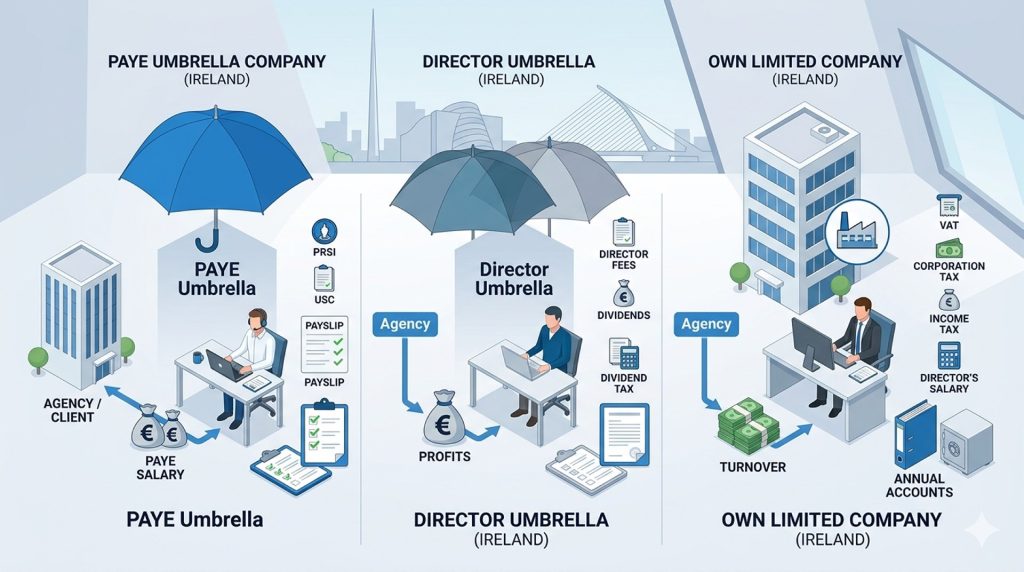
Director Umbrella Company
You are appointed as a director of the umbrella rather than an employee. Class S PRSI applies. Annual self-assessment required. Broader expense rules (more aligned with limited company directors). Typically produces a higher take-home pay on higher day rates. Better for experienced contractors on longer-term, higher-rate engagements with significant claimable expenses.
Personal Limited Company (Personal Service Company)
You form and own your own private limited company. Maximum control over your tax planning, profit extraction, and business structure. Annual accounts, CRO filings, and corporation tax returns are required. Usually requires an accountant. Highest potential for tax efficiency on sustained, high-rate contracting. Most administrative burden. Best for contractors who are established, long-term, and on consistently high rates.
The right choice depends entirely on your day rate, contract length, expense profile, PRSI priorities, and appetite for administration. A good provider will discuss all three options with you honestly before recommending one.

Who Is the PAYE Umbrella Company Best Suited To?
It works particularly well for:
- First-time contractors making the move from permanent employment
- Contractors on short or fixed-term assignments (generally under 12 months)
- Healthcare professionals locum doctors, nurses, and allied health workers on rolling placements
- IT and technology contractors starting their first commercial engagement
- Engineering and construction professionals on project-based contracts
- Anyone with visa restrictions that make forming a limited company impractical
- Contractors who are in the process of applying for a mortgage and need to demonstrate regular employment income
- International contractors arriving in Ireland who need a fast, compliant payroll arrangement from day one
It is less well-suited for:
Contractors who want to build retained profits, invest through a business structure, or plan for retirement through their company
Experienced contractors on day rates above €400–€500 who have been contracting consistently for more than 12 months
Those with strong expense profiles (significant travel, equipment, professional costs) who would benefit from the broader director or limited company expense rules
How to Choose the Right PAYE Umbrella Company in Ireland
The quality of umbrella companies operating in Ireland varies considerably. Choosing the wrong one is more than an inconvenience it can result in incorrect tax deductions, delayed payments, Revenue compliance issues, or simply very poor service. Here is what to look for.
Revenue compliance: Your provider must be registered for employer PAYE with Revenue and must demonstrate that they remit all taxes correctly and on time under the PAYE Modernisation (PMOD) system. Ask for confirmation of their Revenue registration.
Transparent, fixed fees: The clearest fee structure is a fixed weekly or monthly amount. Be cautious of providers who charge a percentage of your gross earnings on higher contract rates, this can become significantly expensive. There should be no joining fee, no exit fee, and no charges during gaps between contracts.
Clear payslips every pay period: Every payment must be accompanied by a payslip that shows gross pay, each deduction (PAYE, PRSI, USC, employer PRSI, service fee), and net pay. If a provider cannot show you a sample payslip before you join, that is a concern.
A dedicated point of contact: Contracting is dynamic. Contracts change unexpectedly. Rates change. Personal circumstances change. You need a provider who assigns you a specific person not a ticket queue and who responds promptly when you need guidance.

Irish-based and Irish-regulated: Your umbrella company should be based and regulated in Ireland, operating under Irish employment law and the Irish PAYE system. Some non-Irish providers offer services to Irish contractors the compliance and support complexity this introduces is generally not in your interest.
Honest guidance on model suitability: A provider who only offers PAYE umbrella and recommends it regardless of your situation is not giving you full advice. Look for providers who will tell you honestly when a Director model or a limited company would serve you better.
Umbrella Companies and Revenue Audits What You Need to Know
A question contractors sometimes ask: does being paid through an umbrella company reduce your risk of a Revenue audit or inquiry?
The honest answer is nuanced. Working through a compliant PAYE umbrella company means your payroll taxes are processed in real-time by a professional employer reducing the risk of payroll errors that could attract Revenue's attention. Your PAYE record is accurate, your PRSI contributions are correct, and your payslips are detailed and compliant.
However, if you are processing expenses through your umbrella arrangement, Revenue can and does audit expense claims made by contractors. Inflated or non-allowable expense claims are a known risk area. This is why choosing an umbrella company that applies strict expense compliance and advises you correctly on what is and is not allowable matters for your personal Revenue risk profile.
Common Mistakes Irish Contractors Make with PAYE Umbrella Companies
Choosing based on price alone: The cheapest umbrella is rarely the best one. Providers who undercut the market often do so by compromising on compliance, support, or both. The cost of those compromises in Revenue penalties, delayed payments, or poor advice far exceeds any fee saving.
Not understanding the dual PRSI contribution: Some contractors are surprised when they see both employee and employer PRSI deducted through their umbrella arrangement. This is not a scam or a trick it is how PAYE umbrella works across the market. Understanding it in advance means no surprises on your first payslip.
Staying on PAYE too long: Many contractors remain on the PAYE model long after their contracting career has grown to the point where a different structure would suit them better. If you are 18 months into a long-term engagement on a strong day rate, it is worth revisiting the question of whether the PAYE model is still the most appropriate fit.
Using a non-compliant scheme: This is the most serious mistake and unfortunately not uncommon. Any scheme that promises take-home pay significantly above standard PAYE deductions through loan arrangements, mini umbrella structures, or offshore mechanisms is almost certainly non-compliant. Revenue is actively challenging these schemes and the tax liability, when it is assessed, falls entirely on the contractor.
Start Your Business Journey Now
Hundreds of startups already growing with TAS Consulting
PAYE Umbrella and Mortgages in Ireland What You Need to Know
For contractors who are planning to apply for a mortgage, the PAYE umbrella model offers a practical advantage that is worth highlighting.
Mortgage lenders in Ireland typically assess affordability based on employment income, payslips, and Revenue records. Contractors operating through their own limited company can sometimes find it more difficult to demonstrate stable, regular income in the format lenders prefer particularly if they are extracting income through dividends rather than salary.
Contractors employed through a PAYE umbrella company receive regular salary payslips, are employed as PAYE workers, and have straightforward Revenue records with no self-assessment returns. Many lenders treat PAYE umbrella contractors in a similar way to regular employees, which can make the mortgage assessment process significantly more straightforward.
If you are planning to apply for a mortgage in the next one to two years, this is a factor worth discussing with both your umbrella provider and your mortgage broker.
Is a PAYE Umbrella Company the Right Choice for You?
For the right contractor in the right circumstances, a PAYE Umbrella Company is genuinely the best place to start. It is fast, clean, fully compliant, and removes every administrative barrier that might otherwise prevent you from starting or continuing your contracting career.
It protects your PRSI entitlements. It handles your taxes. It gives you payslips. And it lets you focus entirely on the work you are actually good at.
It is not the right model for every contractor indefinitely. As your rates grow, your contracts lengthen, and your tax planning needs become more sophisticated, the case for a Director umbrella or a personal limited company strengthens. The key is working with a provider who is honest enough to tell you when that moment has arrived.
TAS Consulting offers both PAYE and Director Umbrella models, as well as company formation and full accounting services. Wherever you are in your contracting career, we will tell you what actually suits your situation not just what is easiest for us to sell.
Ready to Start? Talk to TAS Consulting Today
If you are starting a contract, switching providers, or simply want to understand your options properly for the first time, get in touch with our team. We will review your situation, walk you through the options, and have you set up quickly.
Contact Us
Office Address
Unit 80, Cherry Orchard Business Park, D10NX96, Dublin 10, Ireland
Working Hours
Monday to Friday: 0800 hours – 1700 hours
Saturday & Sunday: Closed
Email or Call Us
Email: moh@tasconsulting.ie
Mobile: +353 85 1477625